
How to Identify UBOs in Complex Ownership Structures
A working method for tracing beneficial owners through holding chains, trusts, partnerships and funds, with the arithmetic shown and the evidence to keep at every layer.

Short Answer
Map every layer of the structure down to natural persons, then run two tests in parallel. For ownership, multiply percentages along each chain and add the chains together; anyone at 25% or more (more than 25% in the UK) is a beneficial owner. For control, identify anyone who steers the entity through voting pacts, vetoes, board appointment rights, nominees or a general partner role. For trusts, identify every party. Name senior managing officials only when no one qualifies.
Key Takeaways
- Indirect ownership: multiply along each chain, add across chains. EU Regulation 2024/1624 writes this into law.
- Ownership and control are separate tests. Someone with a 23% economic stake can still be a beneficial owner through a chain of majority control.
- Trusts have no percentage test in the EU: settlor, trustees, protector and beneficiaries (or the class) all count. The US CDD rule names only the trustee for the ownership prong.
- The senior managing official is a documented last resort, not a shortcut, and is not a beneficial owner.
- The file needs the arithmetic, the documents behind each layer and a signed conclusion.
This is the hands-on companion to our overview of ultimate beneficial ownership and our guide to defensible verification: the method, with numbers.
What Counts as a Beneficial Owner?
A beneficial owner is the natural person who ultimately owns or controls a legal entity or arrangement. Every major framework has an ownership prong and a control prong, but the wording differs in ways that change edge cases.
FATF. Only a natural person can be a beneficial owner, and several people can be beneficial owners of one entity. The March 2023 Guidance on Beneficial Ownership of Legal Persons (Recommendation 24) says an ownership threshold "should not exceed a maximum of 25%" and that ownership is "not the only way" to determine beneficial ownership. Trust guidance under Recommendation 25 followed in March 2024.
US CDD rule (31 CFR 1010.230). Ownership: each individual owning, directly or indirectly, 25 percent or more of the equity. Control: a single individual with significant responsibility to control, manage or direct the entity, such as a CEO, managing member or general partner. Up to four people may qualify on ownership; exactly one is named on control.
EU AMLR (Regulation (EU) 2024/1624, applying from 10 July 2027). Article 52 sets ownership at "25 % or more"; Article 51 requires control via other means to be identified "independently of and in parallel to" ownership.
"More than 25%" versus "25% or more." The current EU directive (Directive (EU) 2015/849, Article 3(6)) uses "25 % plus one share or an ownership interest of more than 25 %", and the UK's Money Laundering Regulations 2017, regulation 5 uses "more than 25%". So a holder at exactly 25% is a beneficial owner under the US rule and the AMLR, but not under UK law or EU national laws until July 2027.
| Framework | Ownership prong | Control prong | If no one qualifies |
|---|---|---|---|
| FATF R.24 / R.10 | Threshold no higher than 25% | Control through other means | Identify the senior managing official |
| US CDD rule, 31 CFR 1010.230 | 25% or more of equity | Always one individual with significant management responsibility | Control person is always named anyway |
| EU AMLR (from 10 July 2027) | 25% or more of shares, votes or other ownership interest | Parallel test: votes, board rights, vetoes, agreements, nominees | Senior managing officials, with records |
| UK MLR 2017, reg. 5 | More than 25% of shares or votes | Ultimate control over management | Senior managing official |
Decide which frameworks apply before you start. A fund with US and EU investors will often run the EU parallel-control test and the US single-control-person rule on the same file.
How Do You Calculate Indirect Ownership?
Multiply the percentages along each chain from the individual to the customer, then add the results of every chain that leads to the same individual. Article 52(1) of the AMLR writes this method into law: indirect ownership is calculated "by multiplying the shares or voting rights" held through the intermediate entities "and by adding together the results from those various chains", taking into account "all shareholdings on every level of ownership".
The US CDD rule prescribes no formula, but the same method is the defensible way to show your work.
Worked example 1: a three-layer chain with two paths
Cedar Investments LLC is subscribing as an LP. It is owned 70% by Birch Holdings Ltd, 24% by Daniel Ortiz and 6% by Elena Park. Birch is owned 40% by Maria Costa and 60% by Alder Capital SA. Alder is owned 55% by Tom Reyes, 35% by Sofia Lind and 10% by Maria Costa. All names and figures are illustrative.
- Maria Costa, path 1: 40% of Birch × 70% of Cedar = 28.0%.
- Maria Costa, path 2: 10% of Alder × 60% of Birch × 70% of Cedar = 4.2%.
- Maria Costa, total: 28.0% + 4.2% = 32.2%. A beneficial owner under every framework. Path 1 alone suffices, but show both: path 2 is what an examiner checks you did not miss.
- Tom Reyes: 55% × 60% × 70% = 23.1%. Below 25% on economics.
- Sofia Lind: 35% × 60% × 70% = 14.7%. Not a beneficial owner.
- Daniel Ortiz: 24% direct. Not a beneficial owner, but one point below the threshold warrants a question about side agreements or family ties.
- Elena Park: 6% direct. Not a beneficial owner.
Check: 32.2 + 23.1 + 14.7 + 24 + 6 = 100%. If look-through stakes do not sum to 100%, a holder is missing.
Tom Reyes is the interesting one. He holds a majority of Alder, which holds a majority of Birch, which holds a majority of Cedar. Under AMLR Article 53(2), control through ownership means "50 % plus one" of shares or votes, and indirect control exists "where the direct control is identified on each level". Article 54 makes the person controlling an entity that directly owns the customer a beneficial owner. So Tom qualifies in the EU despite a 23.1% economic stake. Under the US rule he is not an ownership-prong owner, but record that you considered him.
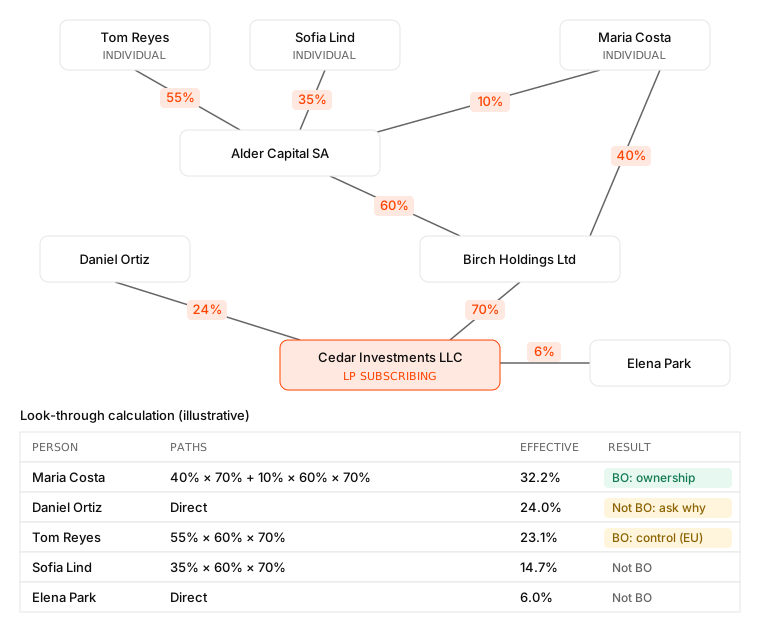
Figure 1. Worked example 1 (illustrative names and figures). Multiply along each chain, add across chains. Maria Costa reaches 32.2% through two paths. Tom Reyes is at 23.1% economically but controls Cedar through a majority at every layer, which makes him a beneficial owner under AMLR Articles 53 and 54.
Sanctions work differently. OFAC's 50 Percent Rule does not multiply: per FAQ 401, if a blocked person owns 50% of Entity A and A owns 50% of Entity B, B is blocked. Run the two analyses separately on the same chart (see our guide to OFAC screening for US funds).
How Can Someone Control an Entity Without Owning It?
Through rights that sit outside the share register. AMLR Article 53(3) lists the minimum cases: majority voting rights, the right to appoint or remove most of the board, "relevant veto rights or decision rights attached to the share", and decisions on profit distribution. Article 53(4) adds agreements, voting arrangements, family relationships and nominee arrangements. Look for:
- Voting agreements. Three 15% holders bound to vote together act as one 45% block. FATF notes countries "may consider combined ownership interests".
- Veto rights. A minority holder who can block budgets, distributions or a sale can control strategy.
- Golden shares and share classes. One share carrying board appointment or veto rights is control. FATF warns a holding "well below a specified threshold" may confer control through differential voting rights.
- Board appointment rights. Appointing a majority of directors is control; FATF says the right to appoint one representative is not, by itself.
- Nominee directors and shareholders. The nominator is the person you need.
- Debt terms. FATF flags convertible debt and lender control rights; ordinary bank financing rarely amounts to control.
Ask for the shareholder agreement, the articles or operating agreement, and side letters. A register only answers the ownership question.
Who Is the Beneficial Owner of a Trust?
Under FATF Recommendation 25 and the AMLR, every party to an express trust counts, regardless of economic share; settlor, trustees, protector, beneficiaries or class, and anyone else with ultimate effective control. The US CDD rule is narower: if a trust owns 25% or more of the customer, the trustee is the ownership-prong beneficial owner.
AMLR Article 58 lists the parties. Article 59 covers undetermined beneficiaries: identify the class, and individuals become beneficial owners once identified. Article 60 covers discretionary trusts: identify the "objects of a power" and "default takers". Where a party is a legal entity, such as a corporate trustee, Article 58(3) requires its beneficial owners too. FATF's March 2024 guidance on legal arrangements takes the same approach.
Worked example 2: a family trust behind an LP
Northgate Family Holdings LLC is owned 80% by the Alvarez Family Trust (discretionary) and 20% by Lucia Alvarez. The deed names Jorge Alvarez as settlor, Meridian Trust Company Ltd as trustee, and Ana Ruiz as protector with power to remove the trustee. The class is Jorge's descendants (currently Lucia and Mateo), with a charity as default taker. All names are illustrative.
- Is the trust a significant holder? Yes, at 80%. AMLR Article 55 makes the trust's beneficial owners Northgate's beneficial owners.
- EU analysis: Jorge, Meridian (plus Meridian's own beneficial owners) and Ana are beneficial owners. Lucia and Mateo are identified as objects of a power and become beneficial owners when selected. The charity is identified as default taker.
- US analysis: Meridian, as trustee, is the ownership-prong beneficial owner for the 80%. Lucia's 20% is below 25%. Northgate still names one control person, such as its managing member.
- Do not compute a percentage through a discretionary trust. There is no fixed share to compute. Identify the parties instead.
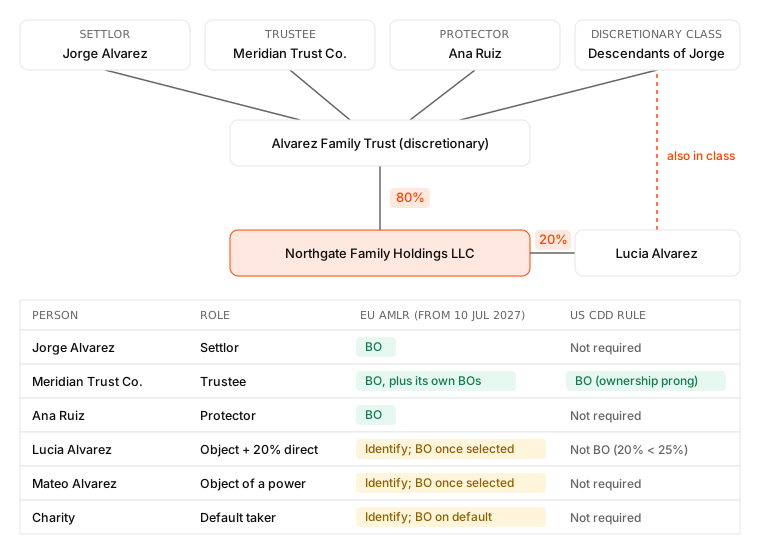
Figure 2. Worked example 2 (illustrative). In the EU every trust party counts, with no percentage test. Under the US CDD rule the trustee stands in for the trust's 80%, and Northgate must still name one control person. "Not required" means the rule does not require it; your risk policy may.
How Do You Identify UBOs in Partnerships and Funds?
For a limited partnership, start with the general partner: the individuals who own or control the GP are usually the control-side beneficial owners. Then apply the ownership test to the limited partners' interests. The US CDD rule names "General Partner" as a control example, and FATF notes partnership control can come from the right to "direct or veto the investment decisions".
When the investor is itself a fund, as with a fund of funds subscribing to your vehicle, the frameworks diverge:
- EU: AMLR Article 61 makes beneficial owners of a collective investment undertaking those who hold 25% or more of the units, who can "define or influence the investment policy", or who control it by other means. Usually that means the people behind the manager, plus any large investor.
- US: Under 31 CFR 1010.230(e)(2)(xi), a pooled investment vehicle operated or advised by an excluded financial institution, such as an SEC-registered adviser, is not a legal entity customer at all. One operated by a non-excluded institution is subject to the control prong only under (e)(3).
Look through to the underlying investors when the fund is small, new, has few investors or an unregulated sponsor. A "fund" with two investors is a holding company with a different name.
On the US position: the CDD rule binds banks, broker-dealers, mutual funds and futures firms. FinCEN's investment adviser AML rule, effective 1 January 2028, left beneficial ownership collection to "a subsequent rulemaking". Most managers apply the CDD definitions anyway because banks, administrators and EU investors expect it (see our piece on the 2028 adviser rule).
When Can You Stop Tracing? Listed and Regulated Entities
You can stop at a layer the framework exempts, usually a listed company or regulated institution, but only with evidence of the exemption.
Under the US rule, 1010.230(e)(2) excludes SEC-reporting issuers, registered investment companies and advisers, banks, state-regulated insurers and, via 31 CFR 1020.315, NYSE- and Nasdaq-listed companies and their US subsidiaries at least 51% owned. If an excluded entity holds 25% or more, "no individual need be identified" for that interest.
The EU is narrower. AMLR Article 65 relieves a listed company of its own duty to register beneficial owners only where control rests with voting-rights holders and "no other legal entities or legal arrangements" sit in its structure. The recitals say this "should not affect the obligation of obliged entities to identify the beneficial owner of a customer". A listed customer may support simplified due diligence on a risk basis, which "does not equate to an exemption". Keep the listing or register entry and the date you checked it.
How Do Nominees, Bearer Shares and Circular Ownership Affect UBO Identification?
All three break the link between the register and the real owner.
Nominees. Ask directly whether any holder or director is a nominee and obtain the nominee agreement. AMLR Article 66 requires nominees to disclose their nominator and its beneficial owners to the entity, which reports them to obliged entities. Calculate on the nominator.
Bearer shares. Revised Recommendation 24 requires countries to stop new bearer shares and to convert or immobilise existing ones. AMLR Article 79 prohibits companies from issuing them and suspends voting and distribution rights on unconverted bearer shares after 10 July 2029, with an exception for listed or intermediated securities. If bearer instruments remain, get a custodian or immobilisation record, or treat ownership as unknown.
Circular ownership. Company A owns 30% of B, which owns 40% of A. None of these frameworks gives a formula for loops, and multiplying round the circle tells you nothing about who is in charge. Trace outward instead: find the holders of each looped entity who sit outside the loop, and who controls the boards. Ask why the loop exists.
What If No One Meets the Threshold?
Then you record the senior managing officials, document every step you took, and keep the reasoning on file. This is the fallback, not a beneficial owner finding.
FATF says the senior managing official provision "does not amend or supersede the definition of who the beneficial owner is". The AMLR recitals say officials "are not the beneficial owners" and that "difficulties in obtaining the information should not be a valid reason" to fall back. Obliged entities that do fall back must verify the officials and "keep records of the actions taken as well as of the difficulties encountered". Article 63(4) defines senior managing officials as executive members of the management body and those running day-to-day management.
In the US, the control prong always names one individual, so a file is never empty, though the ownership prong can return zero names.
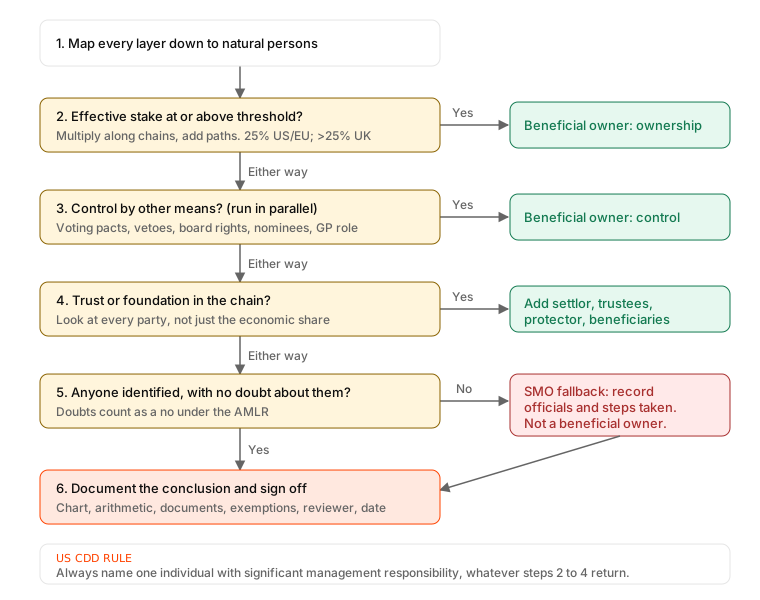
Figure 3. Decision tree for a single customer. Steps 2, 3 and 4 run on the same structure chart and are not alternatives: a person can qualify under more than one, and finding an owner does not end the control test.
Red Flags in Ownership Structures
None proves anything alone. Each should produce a question, an answer and a file note.
- Holdings clustered just under the threshold (24%, 24.9%) or split evenly among relatives.
- Layers across jurisdictions with no operating reason; FATF warns such structures can "slip through the cracks".
- Nominee directors or shareholders, or a corporate services provider listed as the sole director.
- Bearer shares, or share classes with unusual voting or veto rights.
- Circular holdings, or entities formed shortly before the subscription.
- A trust deed that cannot be produced, or a protector with powers that are not explained.
- An organization chart whose percentages do not reconcile with the registers.
- Reluctance to name the people behind a fund-of-funds or holding vehicle.
What Evidence Should You Collect at Each Layer?
Collect a source document for every percentage and control right on the chart plus a certification tying the chart together. The US rule lets you rely on the customer's information only absent facts that reasonably call it into question.
| Layer | Evidence | What it proves |
|---|---|---|
| Customer entity | Formation documents, registers of members and directors, operating or shareholder agreement | Direct holders, share classes, control rights |
| Whole structure | Ownership chart with percentages, classes and jurisdictions, dated and signed by a director or officer | The customer's own representation of the full chain |
| Each intermediate entity | Registry extract or certified share register, articles or constitution | Each percentage on the chart, special rights, nominees |
| Trusts and foundations | Trust deed and any deeds of appointment or variation, trustee certificate naming all parties | Settlor, trustees, protector, beneficiaries or class, powers |
| Partnerships and funds | LPA, GP ownership, management agreement, investor concentration confirmation | Control through the GP or manager, any 25% holders |
| Exempt layers | Exchange listing or regulator register entry, dated | Basis for stopping the trace |
| Each beneficial owner | Identity verification, address, sanctions, PEP and adverse media screening | That the person exists and their risk profile |
For US entities there is no federal register to cross-check. FinCEN's final rule of 11 August 2026 permanently removed beneficial ownership reporting for US companies; only certain foreign reporting companies still file. See our posts on the CTA rollback and Delaware, Wyoming and Nevada entities.
How Should You Document the UBO Conclusion?
Write a short record that a stranger to the file could follow from chart to names. Examiners judge the reasoning, not just the result.
- Threshold and framework, plus any lower internal threshold for higher-risk customers.
- The certified, dated chart.
- The arithmetic, as in Figure 1, with all paths.
- The control analysis: documents reviewed, rights found, holders.
- Trust parties, by role, with the deed reference.
- Exemptions relied on, with the evidence.
- Red flags and how each was resolved.
- The result: beneficial owners by prong, the US control person, or the SMO fallback with the reasons.
- Sign-off and re-review triggers. FinCEN's February 13, 2026 exceptive relief order ties re-identification to first account opening, facts that question the information, and risk-based ongoing diligence: a sensible model.
Store it with the evidence; see our guide to an exam-ready AML audit trail.
How Verifica Supports UBO Identification
Verifica runs UBO mapping for companies, trusts and fund-of-funds investors in the same guided flow as identity, document and screening checks. Investors upload registers, charts and trust deeds from a phone or laptop through forms tailored to their investor type, and each individual identified is screened against LSEG Risk Intelligence for sanctions, PEP and adverse media. Anything needing judgement, such as a control right, a nominee or a chart that does not reconcile, goes to a human reviewer rather than being auto-approved.
Once checks complete, Verifica generates a timestamped, exportable KYC file in under 60 seconds. Verifica is software, not a law firm: the threshold you apply, your risk policy and the final sign-off stay with your team.
Frequently Asked Questions
How do you calculate indirect beneficial ownership?
Multiply the percentage held at each layer of a chain, from the individual to the customer, then add the results of every chain leading to the same person. If Maria owns 40% of a company that owns 70% of the customer, her indirect stake is 28%. A second chain worth 4.2% brings her to 32.2%. EU Regulation 2024/1624, Article 52, sets out this method.
Is someone who owns exactly 25% a beneficial owner?
It depends on the framework. Under the US CDD rule (31 CFR 1010.230) and the EU AMLR, which applies from 10 July 2027, the test is 25% or more, so a 25% holder qualifies. Under the UK Money Laundering Regulations 2017 and the current EU directive, the test is more than 25%, so a holder at exactly 25% does not qualify on ownership alone.
Who is the beneficial owner of a trust?
Under FATF Recommendation 25 and the EU AMLR: the settlor, every trustee, any protector, the beneficiaries or class of beneficiaries, and anyone else with ultimate effective control. There is no percentage test, and a corporate trustee's own beneficial owners are identified too. Under the US CDD rule, where a trust owns 25% or more of an entity, the trustee is the ownership-prong beneficial owner.
Can someone be a beneficial owner without owning any shares?
Yes. Control can come from a right to appoint most of the board, veto rights attached to a share, a voting agreement, a nominee arrangement, family ties, or a general partner role. The EU AMLR assesses control in parallel with ownership, and the US CDD rule always names one individual with significant management responsibility, whatever their shareholding.
What happens if no individual meets the 25% threshold?
First check control by other means, which often identifies someone. If no one qualifies after exhausting reasonable steps, record and verify the senior managing officials and document what you tried. FATF and the EU AMLR both stress that a senior managing official is not a beneficial owner, and the AMLR says difficulty obtaining information is not a valid reason to fall back.
Do you need to look through a fund-of-funds investor?
Usually to the manager, sometimes further. EU AMLR Article 61 treats as beneficial owners anyone holding 25% or more of a fund's units or able to influence its investment policy. Under the US CDD rule, a pooled vehicle advised by an SEC-registered adviser is excluded; others face only the control prong. Look through to investors when the fund is small, new or thinly regulated.
Do listed companies need UBO identification?
In the US, usually not: the CDD rule excludes SEC-reporting issuers, NYSE- and Nasdaq-listed companies and their majority-owned US subsidiaries. The EU is stricter. The AMLR spares qualifying listed companies from registering their own beneficial owners, but obliged entities must still identify a customer's beneficial owners, though simplified due diligence may apply on a risk basis.
Sources
- 31 CFR 1010.230, Beneficial ownership requirements for legal entity customers (FinCEN CDD rule, via Cornell LII, current text).
- 31 CFR 1020.315, Transactions of exempt persons (Cornell LII, current text).
- Regulation (EU) 2024/1624 (AMLR), Articles 51 to 66, 79 and 90 (EUR-Lex, adopted 31 May 2024).
- Directive (EU) 2015/849, Article 3(6), consolidated text (EUR-Lex, version of 30 June 2021).
- The Money Laundering, Terrorist Financing and Transfer of Funds Regulations 2017, regulation 5 (legislation.gov.uk).
- Guidance on Beneficial Ownership of Legal Persons (FATF, March 2023).
- Guidance on Beneficial Ownership and Transparency of Legal Arrangements (FATF, March 2024).
- OFAC FAQ 401, 50 Percent Rule: indirect ownership (US Treasury, revised guidance of 13 August 2014).
- FinCEN Permanently Ends Beneficial Ownership Reporting Requirements for Millions of Small Business Owners (US Treasury, 11 August 2026).
- More Is Not Always Better: FinCEN Grants Risk-Based Relief from Repeat Beneficial Ownership Verification Requirements (Mayer Brown, February 2026).
- FinCEN Adopts Final AML Program Rule for Investment Advisers (Goodwin, 18 September 2024).
- FinCEN Finalizes Two-Year Delay of the Investment Adviser AML Rule (Proskauer, 14 January 2026).
Rodolfo Santos is a real estate compliance attorney with 10+ years of experience in cross-border transactions and the co-founder of Verifica, an AI-powered compliance platform for real estate professionals. He has closed over 150 property transactions worth more than €50 million.