
How to Stop Chasing KYC Documents: A Collection and Reminder Playbook
Why investor documents stall, exactly what to ask each investor type for, a day-by-day reminder cadence with copy you can reuse, and the numbers that tell you whether it is working.

Short Answer
You stop chasing KYC documents by asking correctly the first time: a list tailored to the investor type, named acceptable alternatives, certification and recency rules stated up front, and a secure upload link instead of email. Then run a fixed reminder cadence (for example day 0, 2, 5, 9 and 14) that names the exact gap, escalates to the relationship owner or GP at day 14, and stops the moment the file is complete.
Key Takeaways
- Most chasing is self-inflicted: generic checklists, vague asks and rejected documents generate the follow-ups.
- Request by investor type and say what you will accept instead. Individuals, joint holders, companies, trusts, partnerships, fund-of-funds and nominees each need a different list.
- Guidance uses words like "recent" and "current" for proof of address. Any fixed window, such as 90 days, is your own policy choice, so write it down and apply it consistently.
- Reminders should name the missing item, come from a known sender and escalate to a human with the relationship by day 14.
- Do not accept identity documents over plain email. Collect through an encrypted portal and set retention and deletion rules from day one.
This guide is the operational companion to Boosting KYC Response Rates, which covers the psychology of drop-off. Here the focus is narrower: the document request itself, the reminder sequence, and what to do when something comes back wrong.
Why Do KYC Document Requests Stall?
Requests stall because the investor cannot tell what you need, sends the wrong thing, or cannot send it the way you asked. In practice, most of a fund operations team's follow-ups trace back to seven causes, and each one is fixable before the first email goes out.
- Unclear asks. "Please send KYC documents" forces the investor to guess. Name every item with an example.
- The wrong document requested. Asking a trust for a certificate of incorporation guarantees a second round.
- Generic checklists. One list for every investor type buries the few items an individual needs under many that only apply to companies.
- Email attachments. Scans bounce, get stripped by filters or sit in a shared inbox, and they create a data-protection problem.
- Expiry and recency. An expired passport or last year's utility bill is rejected, and the investor feels they already complied.
- Late certification requirements. If you need a certified copy, say so at the start and say who can certify.
- Signatory confusion. The person filling in an entity's form is often neither the signatory nor a beneficial owner.
Fixing these is cheaper than sending more reminders.
What Documents Should You Request From Each Investor Type?
Request only what your policy requires for that investor type, and list acceptable alternatives next to each item. The matrix below reflects the documentary examples in FinCEN's customer identification rule, the beneficial ownership rule at 31 CFR 1010.230, the JMLSG guidance used in the UK, and the Cayman Islands Monetary Authority (CIMA) Guidance Notes. Your own procedures, risk rating and jurisdiction decide the final list.
A note on the US position: there is no customer identification rule for investment advisers yet. FinCEN's adviser AML rule now takes effect on January 1, 2028, and the joint SEC and FinCEN identification proposal for advisers remains a proposal (Morrison Foerster, January 2026). Most funds model collection on the bank rule at 31 CFR 1020.220, whose examples are unexpired government-issued photo ID for individuals and "certified articles of incorporation, a government-issued business license, a partnership agreement, or trust instrument" for entities. See the 2028 adviser rule explainer for what changes then.
| Investor type | Core request | Acceptable alternatives | Certification and signatory notes |
|---|---|---|---|
| Individual | Photo ID (passport, national ID card or driver's license); proof of residential address | For address: bank or card statement, utility bill, tax or benefits letter. For people in temporary accommodation, CIMA accepts an employment contract, lease, or banker's or employer's letter | Unexpired ID. Certified copy if verified remotely from a paper copy and your policy requires it |
| Joint holders | The individual set for each holder | As for individuals, per holder | Both holders sign. Do not accept one holder's documents for both, even at the same address |
| LLC or corporation | Formation certificate; operating agreement or articles; register of members or ownership chart; list of directors or managers; signatory authority (board resolution or manager consent) | Certificate of good standing; registry extract; certified copy if the original cannot be seen | Identify each individual owning 25% or more, plus one control person (31 CFR 1010.230). Verify the signatory, who may be neither |
| Trust | Trust instrument or certified extracts; identity of trustee(s) | Certification of trust, where local law allows; registry reference where one exists | CIMA lists settlor, trustees, protector, enforcer, beneficiaries or class, and anyone with ultimate control. Trustee signs |
| Partnership (LP or GP) | Partnership agreement or certificate of limited partnership; identity of the general partner and authorized signatories | Registry extract; latest financial statements | CIMA suggests ID for at least two partners or controllers, the GP and signatories |
| Fund-of-funds | Formation documents; manager or GP details; regulatory status evidence; ownership and control chart | Regulated status evidence may support a lighter, risk-based approach where your rules permit | Collect beneficial owners above threshold through the chain. See Ultimate Beneficial Ownership |
| Nominee or intermediary | Nominee's own entity documents; written assurance on the underlying principals | Copies of principals' ID on request, where reliance is permitted | Under CIMA guidance, reliance needs a written assurance that the nominee has verified principals and will supply copies without delay |
Two points cut follow-ups more than any other. First, separate the form filler, the signatory and the beneficial owners at the start, and send each person only their part. CIMA tells firms to "exercise caution" and verify signatories who are not directors, managers or employees (CIMA Guidance Notes, February 2024). Second, the beneficial ownership certification under 31 CFR 1010.230 can be given on the Appendix A form "or by another means," so a short web form with an attestation is fine and easier than a PDF to print and scan.
One more idea worth borrowing: a FinCEN order of February 13, 2026 lets banks and broker-dealers stop re-identifying a legal entity customer's beneficial owners at every new account, absent a reason to doubt the earlier information (DLA Piper, March 2026). Funds are not covered, but if an investor's ownership is already verified and unchanged, ask them to confirm it rather than resubmit it.
When do you need certified copies or an apostille?
A certified copy is a copy that a suitable independent person has signed to confirm it matches the original and, for photo ID, that the photo is a true likeness. CIMA gives lawyers, accountants, managers of regulated firms, notaries, judges and senior civil servants as examples, and expects the certifier to sign, print their name, and add their capacity, address and phone number. JMLSG lists certified copies as one way to address non-face-to-face risk (JMLSG Part I, Chapter 5). Give investors the exact wording you want; a missing capacity line is a common reason copies come back.
An apostille is different. Under the 1961 Hague Apostille Convention, it certifies "the authenticity of the signature, the capacity in which the person signing the document has acted and, where appropriate, the identity of the seal or stamp." It says nothing about whether the contents are true and applies only between Contracting Parties. Ask for one only when your policy needs comfort that a foreign notary or official is genuine. Requiring apostilles across the board adds weeks.
What counts as recent proof of address?
The guidance does not set a number. CIMA refers to "a recent rates or utility bill" and JMLSG to "current" bank or card statements. A fixed window, such as 90 days, is a policy choice. Pick one, write it into your procedures, put it in the first request, and apply it the same way to every investor. Figure 1 is a decision flow your reviewers and your request copy can share.
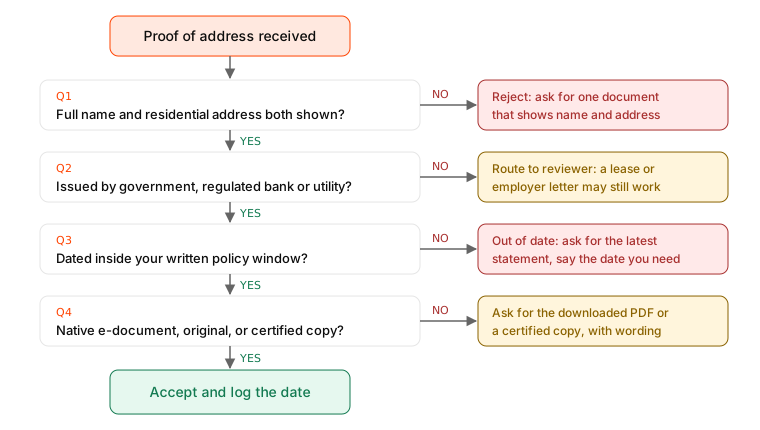
Figure 1. Proof-of-address decision flow. Each "no" maps to a specific follow-up message, so the investor learns exactly what to fix. The policy window in Q3 is yours to set; JMLSG and CIMA say "current" or "recent" without fixing a number.
How Do You Write a First Request That Gets Completed?
A first request gets completed when it is short, specific to the investor, explains why, and contains one link. Build it in this order.
- Classify the investor first. Individual, joint holders or which entity type, and who signs. Everything else depends on this.
- Send from a named person the investor recognizes. Copy the relationship owner. A no-reply address asking for a passport reads like phishing.
- List items, not categories. "A photo of your passport's data page" beats "identity documents." Add the acceptable alternative on the same line.
- State the rules once, up front. Expiry, the proof-of-address window, whether certification is needed and who can certify.
- Give one secure link and a realistic time estimate. If the investor can do it from a phone, say so.
- Give a date and a reason. Tie the deadline to something real, such as the closing date or the capital call.
- Name a human for questions. Include a direct phone number. Many stalls are one unanswered question.
Template 1: first request (individual investor)
Subject: [Fund name] subscription: 3 items needed before [closing date]
Hi [first name], thanks for subscribing to [Fund name]. Before we can accept your subscription we need to verify your identity, as our AML procedures require. It takes about ten minutes and works from your phone.
Your passport data page (or national ID card, front and back). It must be in date.
Proof of your home address dated within the last [90] days: a bank statement, utility bill or tax letter. A downloaded PDF is ideal.
A short form confirming your details and source of funds.
Upload here: [secure link]. Please don't send documents by email.
We need these by [date] to include you in the [closing date] close. Questions? Call me on [number].
[Name], [Fund name] Investor Operations
For entities, split the request by person: the contact gets the entity documents, each beneficial owner gets their own identity link, and the signatory gets the authority document. Investors abroad need extra lead time for certification and translation; see Cross-Border KYC.
What Reminder Cadence Should You Use for KYC Documents?
Use a short, fixed cadence that changes channel and purpose at each step, moves to a human by day 9 and to the relationship owner or GP by day 14. Every reminder should say what is still missing, and all reminders should stop automatically when the file is complete.
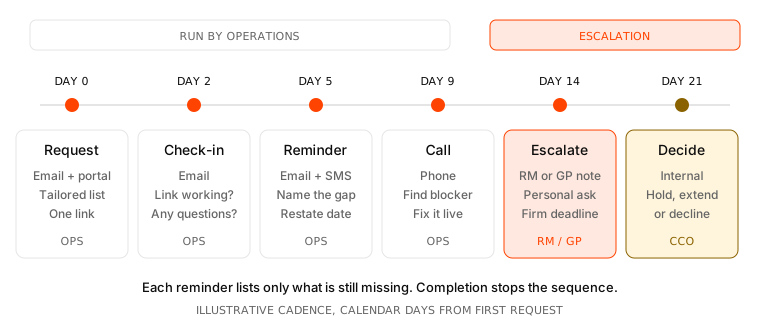
Figure 2. An illustrative reminder cadence. Channels and timing are a starting point, not a regulatory requirement; shorten the gaps when a closing date is near.
| Day | Channel | Purpose | Owner |
|---|---|---|---|
| 0 | Email with portal link | Tailored request: items, rules, deadline, contact | Operations |
| 2 | Confirm the link works; invite questions. Skip if the investor has started | Operations | |
| 5 | Email and SMS | Name the specific missing items; restate the deadline | Operations |
| 9 | Phone call | Find the blocker (certifier, signatory, trustee travel) and agree a fix | Operations |
| 14 | Email from relationship owner or GP | Personal ask, firm deadline, consequence (next close) | RM or GP |
| 21 | Internal | Decide: extend with a date, move to the next close, or decline | CCO |
Three rules make the cadance work. Pause it when the investor asks a question so they are not nagged while waiting on you. Reset it to the day 5 step when a document is rejected. And never skip the escalation: a note from the person who owns the relationship moves files that automated reminders cannot. KYC onboarding time to approval covers the reviewer side of the same clock.
Sample KYC Reminder Email Templates
Good reminders are short, name the exact gap and repeat the link. Adapt these three to your own voice and policy.
Template 2: day 5 reminder (partial file)
Subject: One item left for your [Fund name] subscription
Hi [first name], thank you, we have your passport and form. The only thing missing is proof of your home address dated after [date]. A bank statement downloaded as a PDF works. Upload here: [secure link]. We need it by [date] for the [closing date] close.
Template 3: rejected document
Subject: Quick fix needed on one document
Hi [first name], the [document] you uploaded on [date] is [dated before our 90-day window / cut off at the address line / missing the certifier's capacity]. Could you upload [specific replacement]? Everything else is complete. [secure link]
Template 4: day 14 escalation from the GP or relationship owner
Subject: Your [Fund name] subscription
Hi [first name], I wanted to check in personally. We are still missing [item] and can't accept a subscription until identity checks are complete. If something is getting in the way, reply to me or call [number] and we'll sort it out. To keep your place in the [closing date] close, we need it by [date].
Keep the escalation honest. If the consequence of missing the date is moving to the next close, say that. Do not imply penalties the documents do not provide for.
How Should You Handle Partial Submissions and Rejected Documents?
Accept every valid item as it arrives, reject only the specific item that fails with a reason the investor can act on, and track each document through its own status. A file is a set of documents with separate states, not one yes-or-no.
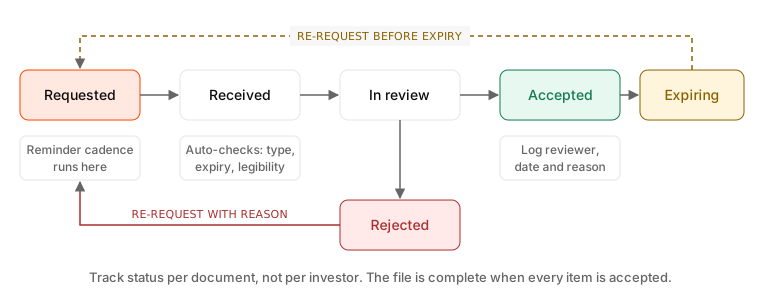
Figure 3. State diagram of one document request. Rejection returns the item, not the whole file, to the requested state; expiry dates feed a re-request before the document lapses.
In practice this means four habits.
- Acknowledge what arrived. Say "we have your passport" before saying what is missing.
- Reject with a reason and a replacement. "Dated March; we need one dated after June 5" gets an upload. "Not accepted" gets a phone call.
- Route judgement calls to a reviewer quickly. A lease instead of a utility bill, or an unfamiliar foreign registry extract, is a review decision. CIMA expects reasonable steps to confirm an unfamiliar document is genuine, which may include contacting the issuing authority or obtaining a notarized translation.
- Record every state change. Who received and reviewed it, when and why. See AML audit trails that are exam-ready.
How Do You Manage Expiring KYC Documents?
Capture expiry dates at intake, decide in your policy which expiries trigger a refresh, and request the replacement before the date passes rather than after. FinCEN's bank rule gives unexpired government-issued photo ID as its example of documentary verification; whether a passport that lapses mid-relationship must be replaced is a matter for your risk-based ongoing due diligence policy.
Log the issue date, expiry date and acceptance date for each document. Then:
- Set a refresh trigger, for example 60 days before a high-risk investor's ID expires, or the next periodic review for standard-risk investors.
- Treat proof of address as point-in-time. Re-collect it on a change of address or at periodic review if your policy requires.
- Re-request entity documents on change: a new signatory, owner above your threshold, trustee or general partner. CIMA says changes to signatories must be verified.
- Batch refreshes so an investor with two expiring documents is asked once.
How Do You Collect KYC Documents Securely and Lawfully?
Collect identity documents through an encrypted upload portal, not plain email, keep only what your policy requires, and set a retention and deletion schedule that matches the AML record-keeping rule that applies to you.
Email is the default channel for chasing and the worst one for receiving.. The UK Information Commissioner's Office cites a case in which an unencrypted file holding special category data of 241 people was emailed to the wrong address (ICO, encryption scenarios). In the US, amended Regulation S-P, adopted May 16, 2024, requires SEC-registered advisers to run an incident response program and notify affected individuals no later than 30 days after becoming aware of certain unauthorized access to customer information (SEC, May 2024). Larger advisers (more than $1.5 billion in assets under management) had to comply by December 3, 2025 and smaller entities by June 3, 2026 (Davis Wright Tremaine, May 2026). Inboxes full of passport scans are the exposure those programs exist to catch.
Practical rules for the operations team:
- When an investor emails a document anyway, upload it to the secure system, delete it from the inbox and reply with the portal link for next time.
- Do not ask for more than your policy requires. Every extra document is extra data you must protect and later delete.
- Restrict who can open KYC files and log access.
- Set retention by jurisdiction. US bank CIP records: identifying information for five years after the account is closed, verification records for five years after the record is made (31 CFR 1020.220). UK: five years after the business relationship ends, after which personal data must be deleted unless an exception applies (MLR 2017, regulation 40). EU: five years from the end of the relationship under Article 77 of Regulation (EU) 2024/1624, which applies from 10 July 2027, with deletion on expiry.
What Metrics Should You Track for KYC Document Collection?
Track how long files take, where they stall and why documents are rejected. Six measures, reviewed monthly by investor type, will show whether your requests and cadence are improving.
| Metric | Definition | What it tells you |
|---|---|---|
| Time to complete file | Median days from first request to all items accepted | Overall health; compare by investor type |
| First-pass acceptance rate | Share of documents accepted on first upload | Quality of your request copy and rules |
| Rejection reasons | Count by reason (expired, out of window, missing certification, wrong document) | Which instruction to rewrite first |
| Reminders per completed file | Average touches before completion | Whether the first request is doing its job |
| Escalation rate | Share of files reaching the day 14 step | Load on GPs and relationship owners |
| Stage of stall | Where open files sit: not started, partial, in review | Whether the delay is with the investor or your reviewers |
The last metric matters more than it looks. If files sit "in review," more reminders will not help; the bottleneck is internal.
Where Verifica Fits
Verifica runs the collection side of this playbook in one guided flow. Smart forms are tailored to the investor type, so an individual, a trust and a fund-of-funds each see only their own list, and investors upload from a phone or laptop rather than email. The same flow runs ID and document authenticity checks, biometric liveness, sanctions, PEP and adverse-media screening through LSEG Risk Intelligence, and UBO mapping for companies, trusts and fund-of-funds. Judgement calls go to a human reviewer, and once checks complete the platform generates an exportable, timestamped KYC file in under 60 seconds. Verifica is software, not a law firm: policy windows, risk thresholds and sign-off stay with your team. For the end-to-end workflow see How to Automate KYC Document Collection and Sanctions Screening for New LPs.
Frequently Asked Questions
How do I stop chasing investors for KYC documents?
Fix the first request before adding reminders. Tailor the list to the investor type, name acceptable alternatives, state expiry, recency and certification rules up front, and give one secure upload link with a real deadline. Then run a fixed cadence that names the missing item each time, moves to a phone call around day 9, escalates to the relationship owner or GP around day 14, and stops automatically when the file is complete.
How often should I send KYC document reminders?
A practical cadence is a request on day 0, a check-in on day 2, a specific reminder on day 5, a phone call on day 9 and a personal note from the relationship owner or GP on day 14, followed by an internal decision. No regulation sets this timing. Shorten the gaps when a closing date is close, and pause reminders while the investor is waiting on an answer from you.
How old can proof of address be for KYC?
UK JMLSG guidance and the Cayman CIMA Guidance Notes describe acceptable address evidence as current or recent without fixing a number of days. A fixed window, such as 90 days, is an internal policy choice. Whatever window you choose, write it into your procedures, state it in the first request, and apply it consistently so reviewers do not make different calls on the same document.
Who can certify a copy of a KYC document?
CIMA lists lawyers, accountants, directors or managers of regulated financial firms, notaries, members of the judiciary and senior civil servants as examples of suitable certifiers. The certifier should sign the copy, print their name, and state their capacity, address and phone number. Firms remain responsible for judging whether a certifier is appropriate, and many keep an approved list in their procedures.
Do I need an apostille on investor KYC documents?
Usually not. Under the 1961 Hague Convention, an apostille certifies the authenticity of a signature, the signer's capacity and any seal on a public document. It does not confirm that the contents are true. Ask for one when your policy needs assurance that a foreign notary or official is genuine, typically for higher-risk files, and only where both countries are parties to the Convention.
Can investors send KYC documents by email?
It is better not to accept them that way. Identity documents sent by plain email can be misdirected, stored in shared inboxes and are hard to delete. Use an encrypted upload portal. If an investor emails documents anyway, move them into your secure system, delete the email copies and send the portal link for next time. SEC-registered advisers should also consider their obligations under amended Regulation S-P.
How long must KYC documents be kept?
It depends on the rule that applies. US bank customer identification rules keep identifying information for five years after account closure. The UK Money Laundering Regulations 2017 require five years after the relationship ends, then deletion of personal data unless an exception applies. The EU AML Regulation, applicable from 10 July 2027, sets five years from the end of the relationship, with deletion on expiry.
Sources
- 31 CFR 1020.220, Customer identification program requirements for banks (Legal Information Institute, Cornell Law School, accessed October 2026).
- 31 CFR 1010.230, Beneficial ownership requirements for legal entity customers (Legal Information Institute, Cornell Law School, accessed October 2026).
- FinCEN issues exceptive relief from beneficial ownership identification and verification requirements at each account opening (DLA Piper, March 2026).
- FinCEN Hits Pause: No AML Rule for Investment Advisers Until 2028 (Morrison Foerster, January 2026).
- Guidance, Part I, Chapter 5: Customer Due Diligence (Joint Money Laundering Steering Group, June 2020 revision).
- Guidance Notes on the Prevention and Detection of Money Laundering, Terrorist Financing and Proliferation Financing in the Cayman Islands (Cayman Islands Monetary Authority, February 2024).
- Convention of 5 October 1961 Abolishing the Requirement of Legalisation for Foreign Public Documents (Hague Conference on Private International Law).
- Encryption scenarios (UK Information Commissioner's Office, accessed October 2026).
- SEC Adopts Amendments to Regulation S-P to Enhance Protection of Customer Information (U.S. Securities and Exchange Commission, May 16, 2024).
- Reminder: "Smaller Entities" Must Comply with Amended Regulation S-P by June 3, 2026 (Davis Wright Tremaine, May 2026).
- The Money Laundering, Terrorist Financing and Transfer of Funds (Information on the Payer) Regulations 2017, regulation 40 (legislation.gov.uk).
- Regulation (EU) 2024/1624, Article 77: Retention of records (OJ L, 19.6.2024, via Springlex).
- Regulation (EU) 2024/1624 of 31 May 2024 (EUR-Lex, Official Journal of the European Union, 19 June 2024).
Rodolfo Santos is a real estate compliance attorney with 10+ years of experience in cross-border transactions and the co-founder of Verifica, an AI-powered compliance platform for real estate professionals. He has closed over 150 property transactions worth more than €50 million.