
Enhanced Due Diligence (EDD) for Private Fund Investors: A Practical Guide
When a limited partner needs more than standard KYC: the triggers, how to evidence source of wealth and source of funds, how deep to trace ownership, and how to write an EDD decision an examiner will accept.

Short Answer
Enhanced due diligence (EDD) for private fund investors is the extra layer of checks you run when an investor presents higher risk: a politically exposed person, a high-risk jurisdiction, a layered ownership chain, adverse media or an unusual funding route. In practice it means three things on top of standard KYC: evidence of source of wealth, evidence of source of funds, and ownership traced to every person who owns or controls the investor. It ends with a written memo and a decision by someone senior enough to say no.
Key Takeaways
- EDD is triggered by risk, not by ticket size alone. Write the triggers down before the first subscription arrives.
- Source of wealth explains the person. Source of funds explains the wire. A good file has both and a believable link between them.
- Covered U.S. advisers will owe special due diligence for certain private banking relationships with non-U.S. persons once the Investment Adviser AML Rule takes effect on January 1, 2028.
- The EDD memo is the deliverable. If the reasoning is not on paper, the diligence did not happen as far as an examiner is concerned.
- Approval is a named, senior decision, and an approved high-risk investor moves into a tighter monitoring tier.
What is enhanced due diligence for a fund investor?
Standard customer due diligence answers four questions about every investor: who they are, who owns and controls them, whether they appear on a sanctions or PEP list, and what risk rating they carry. For most limited partners that is enough. A domestic pension plan, a university endowment or a U.S. individual with a clean screening result and a wire from their own brokerage account does not need more.
Enhanced due diligence is what you do when the answers to those four questions leave real doubt. It goes deeper on the same subjects rather than adding new ones. You ask how the investor came to have the money, where this particular payment comes from, and who sits at the end of every ownership layer. Then you write down what you found, what you could not resolve, and why the residual risk is acceptable or not.
The distinction matters because funds tend to get EDD wrong in one of two directions. Some apply it to everyone, which buries the compliance team, frustrates institutional LPs and produces thin, box-ticking files. Others apply it to almost no one, because the fund administrator's standard onboarding pack looked complete. Neither survives scrutiny. The point of EDD is proportionality: more effort exactly where the risk is.
Is EDD legally required for private fund advisers?
It depends on where the fund and the adviser sit, but the direction is the same everywhere.
United States. FinCEN's Investment Adviser AML Rule, now effective January 1, 2028, requires covered registered investment advisers and exempt reporting advisers to run a risk-based AML/CFT program. That program must include ongoing customer due diligence: understanding the nature and purpose of each customer relationship to build a risk profile, and monitoring to identify and report suspicious activity. A risk-based program that treats a foreign PEP the same as a domestic pension fund is not risk-based. The rule also brings advisers under the existing special due diligence requirements for correspondent and private banking accounts at 31 CFR 1010.610 and 1010.620. A private banking account in that regulation is one with a minimum of $1 million in assets, established for one or more non-U.S. persons, and assigned to an employee who acts as liaison. Where a senior foreign political figure is involved, the regulation requires enhanced scrutiny aimed at detecting proceeds of foreign corruption.
Separately, OFAC sanctions obligations apply to every U.S. person today, with no 2028 start date. Sanctions risk is strict liability, and an ownership chain you did not trace is a sanctions exposure you did not see. Our guide to OFAC screening for U.S. private funds covers the 50 Percent Rule in detail.
United Kingdom, EU and offshore centers. The UK Money Laundering Regulations 2017 make EDD mandatory for specific situations, including PEPs and business with persons established in high-risk third countries, and require it wherever the firm identifies higher risk. The EU framework does the same, and the Cayman Islands, Luxembourg and Ireland, where many fund vehicles are domiciled, impose comparable requirements on the fund or its administrator. If your fund is offshore, someone is already doing EDD under local law. The question for the adviser is whether that work meets the adviser's own program, and whether you can see it.
Which investors should trigger enhanced due diligence?
Write the triggers into your risk methodology so the decision is mechanical and consistent. Any one trigger moves the investor into EDD. The reviewer can then decide how far to go, but not whether to start.
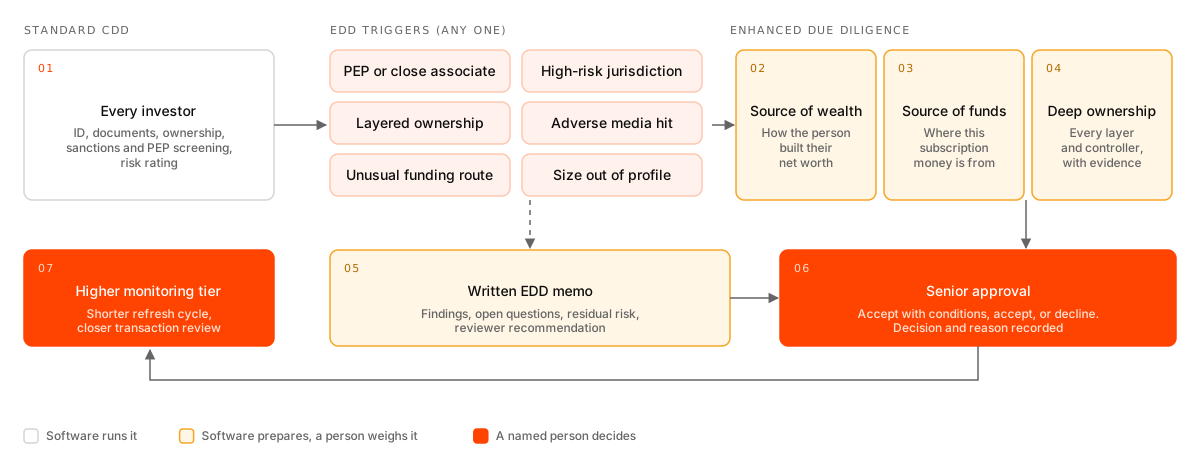
Figure 1. From standard CDD to an EDD decision. Any single trigger opens the EDD file; the approval and the move to a higher monitoring tier are decisions a named person makes.
| Trigger | Why it raises risk | What to add to the file |
|---|---|---|
| PEP, family member or close associate | Exposure to proceeds of corruption | Source of wealth with documents, public role and dates, approval by senior management |
| High-risk jurisdiction | Weak AML regimes, FATF listing, sanctions proximity | Reason for the investment route, banking chain, local registry extracts |
| Layered or opaque ownership | Hides the real owner or a sanctioned party | Structure chart to natural persons, formation documents at each layer, trust deeds |
| Adverse media | Possible link to fraud, corruption or sanctions evasion | Source review, relevance assessment, investor explanation where appropriate |
| Unusual funding route | Third-party or offshore payment breaks the link between investor and money | Account holder evidence, reason for the route, statement history |
| Commitment far out of profile | Wealth may not support the ticket | Net worth evidence, liquidity event documents |
Two further triggers are worth adding for advisers. The first is any investor that sits in a nominee or omnibus structure where you cannot see the underlying holders. The second, flagged in Treasury's 2024 Investment Adviser Risk Assessment, is investment from parties connected to foreign states that may be seeking access to sensitive technology through venture and private funds. That is a national security concern as much as a money laundering one, and it belongs in your trigger list if you invest in technology companies.
What is the difference between source of wealth and source of funds?
These two terms are used interchangeably in many subscription documents, and that is where weak EDD files start.
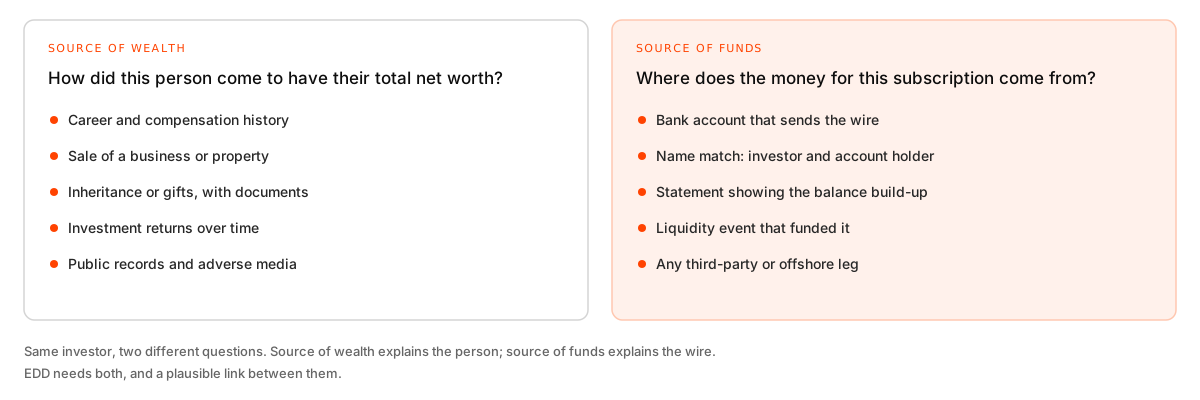
Figure 2. Source of wealth explains how the investor became wealthy. Source of funds explains this particular payment. EDD needs both, and they should tell the same story.
Source of wealth is the origin of the investor's total net worth: a career in medicine, the sale of a logistics business in 2019, an inheritance, decades of investment returns. You are testing whether the investor's wealth as a whole is plausible and legitimately acquired.
Source of funds is the origin of the specific money that will meet this commitment and each capital call: which account sends it, in whose name, and how the balance came to be there.
The test that matters is the link. A surgeon with a documented career and a wire from her own U.S. brokerage account tells a coherent story. A surgeon whose subscription arrives from a company in a third country she has never mentioned does not, however good her career documents look.
How much evidence is enough?
Treat evidence as a ladder and climb only as far as the risk requires:
- Investor declaration. A signed statement of source of wealth and source of funds. Necessary, never sufficient for EDD.
- Corroborating public information. Company registry filings, press coverage of a business sale, public salary disclosures, property records.
- Third-party documents. Sale and purchase agreements, probate documents, audited accounts, tax filings, a letter from a regulated accountant or lawyer.
- Bank evidence. Statements showing the balance build-up and the outgoing wire, with the account holder name matching the investor.
A foreign PEP with a $10 million commitment should reach rung three or four. A domestic individual flagged only for a minor adverse media item may stop at rung two once the media item is resolved as irrelevant.
How deep should ownership tracing go in EDD?
Standard practice in the U.S. borrows the 25 percent ownership threshold and single control person from the bank customer due diligence rule. For EDD, that threshold is a floor, not a target. Many firms lower it to 10 percent for high-risk investors, and you should always identify anyone who exercises control regardless of percentage: trustees, protectors, managers of an LLC, holders of special voting rights.
Sanctions screening adds a separate arithmetic. Under OFAC's 50 Percent Rule, an entity owned 50 percent or more in aggregate by blocked persons is itself blocked, even if it appears on no list. Two sanctioned owners at 25 percent each create a blocked investor that a 25 percent KYC threshold would only partly surface. EDD on a layered investor means mapping every owner you can see, not only those over a line.
For the mechanics of tracing through trusts, partnerships and holding chains, see how to untangle complex ownership structures and why U.S. entity structures are the hardest KYC problem.
How do you write an EDD memo that holds up?
The memo is what an examiner, auditor or institutional LP's due diligence team will actually read. It should stand on its own without the reader opening twenty attachments. Keep it to two pages and use the same structure every time:
- Investor and relationship. Who they are, commitment size, fund, expected capital flows.
- Trigger. Which rule in your methodology opened EDD.
- Ownership and control. The chart to natural persons, with the evidence used at each layer.
- Source of wealth. Narrative plus the documents relied on.
- Source of funds. The paying account, its holder, and how the balance arose.
- Screening results. Sanctions, PEP and adverse media hits, with a disposition for each.
- Open points. What you could not verify and why.
- Residual risk and recommendation. Accept, accept with conditions, or decline, and the conditions.
The open points section is the one most often missing and the one examiners value most. A memo that claims everything was resolved for a complex foreign structure reads as either superficial or untrue.
Who approves EDD, and what happens after approval?
Approval should sit above the analyst who prepared the file. For PEPs, most frameworks expect senior management sign-off explicitly. For a small adviser, that usually means the AML officer plus a managing partner, recorded with a date and reason.
Approval is not the end. An investor accepted after EDD should carry a higher risk rating, which drives two things: a shorter refresh cycle and closer review of every capital movement.
| Risk tier | Full refresh | Screening | Capital movements |
|---|---|---|---|
| Low | Every 3 years or on trigger | Ongoing, automated | Exception-based |
| Medium | Every 2 years or on trigger | Ongoing, automated | Exception-based |
| High (post-EDD) | Every year or on trigger | Ongoing, with analyst review of every hit | Every call and distribution reviewed against the profile |
These intervals are common market practice, not regulatory requirements. Set your own in the methodology and follow them. A shorter cycle you miss is worse than a longer one you meet. For the event-driven alternative to fixed cycles, see our guide to perpetual KYC for private funds.
What are the most common EDD failures in fund files?
- Declaration only. A tick box reading "proceeds of business activities" is not source of wealth evidence.
- Source of funds never checked against the wire. The memo describes one account; the money came from another.
- Ownership stops at the first entity. The investor is a Cayman SPV, and the file stops there.
- Adverse media hits cleared without a reason. "Not relevant" with no explanation is not a disposition.
- No refresh. The investor was a PEP at onboarding in 2021 and nobody has looked since.
- Relying on the administrator blind. The administrator did EDD under Cayman law, but the adviser has never seen the memo.
Where Verifica fits
Verifica runs the evidence-gathering parts of EDD so your reviewer spends time on judgement rather than collection. It collects and verifies identity and corporate documents, maps ownership down to natural persons with the evidence kept at each layer, and screens every person in the chain against sanctions, PEP and adverse media data from LSEG Risk Intelligence. The result is a timestamped file in which the EDD memo, the documents it relies on and the approval sit together, and ongoing screening keeps running after approval. Verifica is software, not a law firm: your risk methodology, thresholds and decisions stay with your team.
Frequently Asked Questions
When is enhanced due diligence required for a fund investor?
Whenever your risk methodology rates the investor as higher risk. Common triggers are PEP status, a high-risk jurisdiction, layered ownership, adverse media, an unusual funding route and a commitment out of line with the investor's profile. Some situations, such as PEPs, make EDD mandatory under UK and EU law.
Do U.S. investment advisers have to do EDD before 2028?
The Investment Adviser AML Rule takes effect January 1, 2028, but sanctions obligations apply now, and many LPs, banks and administrators already require documented EDD. Building the process now avoids a rushed retrofit across your existing investor base.
What is the difference between source of wealth and source of funds?
Source of wealth is how the investor accumulated their overall net worth. Source of funds is where the specific money for this subscription comes from. EDD should evidence both and show they are consistent.
What documents prove source of wealth?
Depending on the story: sale agreements for a business, probate documents for an inheritance, tax returns or employment records for earnings, audited accounts, or a letter from a regulated accountant or lawyer. A signed declaration alone is not enough for a high-risk investor.
Can the fund administrator do EDD for the adviser?
Yes, the work can be delegated, but the adviser stays responsible. You need access to the administrator's EDD files, a clear statement of whose standard they meet, and periodic quality checks.
How often should a high-risk investor be reviewed after EDD?
Common practice is a full refresh at least annually for high-risk investors, plus immediate review when a trigger event occurs, such as a sanctions designation, an ownership change or new adverse media.
Sources
- FinCEN, Anti-Money Laundering/Countering the Financing of Terrorism Program and Suspicious Activity Report Filing Requirements for Registered Investment Advisers and Exempt Reporting Advisers, final rule, 89 Fed. Reg. 72156 (September 4, 2024).
- FinCEN, final rule postponing the effective date of the investment adviser rule to January 1, 2028 (December 2025).
- 31 CFR 1010.610 and 1010.620, special due diligence for correspondent and private banking accounts.
- U.S. Department of the Treasury, 2024 Investment Adviser Risk Assessment (February 2024).
- OFAC, Revised Guidance on Entities Owned by Persons Whose Property and Interests in Property Are Blocked (50 Percent Rule).
- UK Money Laundering, Terrorist Financing and Transfer of Funds (Information on the Payer) Regulations 2017, regulations 33 and 35.
- FATF, Guidance on Politically Exposed Persons (Recommendations 12 and 22).
Rodolfo Santos is a real estate compliance attorney with 10+ years of experience in cross-border transactions and the co-founder of Verifica, an AI-powered compliance platform for real estate professionals. He has closed over 150 property transactions worth more than €50 million.