
How to Automate Investor KYC: The Workflow, the Human Checkpoints and a 90-Day Rollout
Which steps to hand to software, which to keep with a named reviewer, how to set thresholds and handle false positives, and a 30/60/90-day plan to put it live at a small or mid-size fund.

Short Answer
To automate investor KYC, build one workflow that branches by investor type and let software run the repeatable steps: intake, ID and liveness, document checks, ownership mapping, sanctions and PEP screening, file assembly and ongoing monitoring. Keep people on the judgement calls: risk-rating overrides, match disposition, enhanced due diligence and final sign-off. Write your thresholds down first, pilot on live subscriptions, and scale over about 90 days.
Key Takeaways
- Automation should gather, compare and route, not approve. The EU AMLR (from 10 July 2027) requires "meaningful human intervention" in automated onboarding decisions.
- Most steps are "assist": software prepares the evidence, a person weighs it.
- Write and version the rulebook before configuring any tool.
- Resolve screening alerts with identifiers and record a rationale for every disposition.
- Pick one system of record and gate closing on "approved", not "documents received".
What does it mean to automate investor KYC?
Automating investor KYC means software runs the repeatable collection, verification and screening steps for every subscriber and sends anything that needs judgement to a named person. It does not mean a system approves investors by itself.
In Europe that line is now written into law. Under Article 76(5) of the EU Anti-Money Laundering Regulation, Regulation (EU) 2024/1624, firms may rely on decisions from automated processes or AI systems only if any decision to enter, refuse or maintain a relationship, or to increase or decrease the extent of due diligence, "is subject to meaningful human intervention to ensure the accuracy and appropriateness of such a decision." The regulation applies from 10 July 2027.
US rules have no equivalent text, but OFAC's Framework for OFAC Compliance Commitments (May 2019) expects technology used in internal controls to be "selected and calibrated" to the organization's risk profile and routinely tested. That assumes a person owns the settings and the outcomes.
This guide is the operating playbook for that split. For the document checklist by LP type, see How to Automate KYC Document Collection and Sanctions Screening for New LPs; for technology and cost, The Ultimate Guide to Automated KYC/AML; for build or license, Build vs. Buy.
What are the stages of an automated investor KYC workflow?
A complete workflow has ten stages, from intake to ongoing monitoring, with four human checkpoints: risk rating, match disposition and enhanced due diligence (EDD), approval, and alert review. Figure 1 shows how they connect.
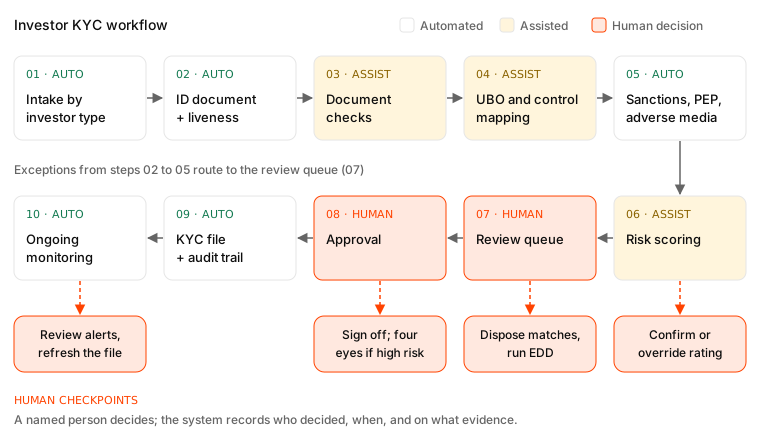
Figure 1. The ten stages of an automated investor KYC workflow. Software runs the white and amber steps; the four orange checkpoints are decisions a named reviewer makes and the system records.
- Intake by investor type. Route the subscriber by type (individual, trust, corporation or LLC, partnership, fund-of-funds, pension, nominee) so each sees only the fields and uploads it needs. Capture tax residence, source of funds and commitment size here; they feed the risk score.
- ID document and liveness. The system checks the document's security features and expiry and matches a live selfie to the photo. Failures go to the review queue, not to silent rejection. The FATF's Guidance on Digital Identity (March 2020) says remote identification using "reliable, independent digital ID systems with appropriate risk mitigation measures in place, may present a standard level of risk, and may even be lower-risk." UK MLR 2017 regulation 28(19) accepts electronic identification that is "secure from fraud and misuse".
- Document checks. Formation documents, trust deeds, signatory lists and proof of address are checked for completeness, date and consistency. Extraction can be automated; accepting an unusual foreign trust deed cannot.
- UBO and control mapping. Collect the ownership chain to each natural person at or above your threshold, plus a control person. 31 CFR 1010.230 uses 25 percent of equity and "a single individual with significant responsibility to control, manage, or direct" the entity; AMLR Article 52 also uses 25 percent, multiplied through each layer. Software does the arithmetic; a person judges whether the structure makes sense. See Beneficial Ownership Verification.
- Screening. Screen every party, not just the subscriber, against sanctions, PEP and adverse-media data. Under OFAC's 50 Percent Rule (FAQ 399), an entity owned 50 percent or more in the aggregate by blocked persons is itself blocked, so screening needs the stage 4 ownership data. See OFAC Sanctions Screening for U.S. Private Funds.
- Risk scoring. The system applies your written rules to produce a provisional rating; a reviewer confirms high ratings and records any override.
- Review queue. Potential matches, failed liveness, missing documents, ownership gaps and high scores land in one queue, each with a reason code, owner and due date.
- Approval. A named approver signs off, with a second approver for high-risk investors.
- KYC file and audit trail. Documents, results, decisions and rationale go into one timestamped file; see How to Build a Defensible AML Audit Trail.
- Ongoing monitoring. A new designation, ownership change, new distribution bank account, transfer of interest or refresh date reopens the file.
Which KYC steps should you automate, assist or keep manual?
Automate steps where the inputs are structured and the right answer does not depend on context. Use "assist" where software can prepare the evidence but a person must weigh it. Keep manual every decision that starts, refuses or ends a relationship, or changes how much due diligence you apply.
| Step | Mode | Software does | A person does |
|---|---|---|---|
| Intake and form routing | Automate | Branches by investor type, validates fields, chases missing items | Approves the form design; handles investors who fit no type |
| ID document and liveness | Automate | Reads the document, checks authenticity and expiry, matches selfie to photo | Reviews failures and low-confidence results |
| Proof of address, formation documents | Assist | Extracts data, checks dates and consistency | Accepts unusual or foreign-language documents |
| UBO and control mapping | Assist | Calculates indirect ownership, flags gaps in lower layers | Judges whether the structure is plausible; confirms the control person |
| Sanctions, PEP, adverse-media screening | Automate | Screens all parties; re-screens when lists or data change | Owns list and threshold settings |
| Match disposition | Keep manual | Shows the list entry beside the investor's identifiers | Decides true or false match and records why |
| Source of funds and wealth | Assist | Collects declarations and supporting evidence | Decides whether the explanation is credible |
| Risk rating | Assist | Calculates a provisional score from written rules | Confirms high ratings; documents overrides |
| Enhanced due diligence | Keep manual | Opens the EDD checklist, requests extra documents | Conducts and concludes the EDD |
| Approval or rejection | Keep manual | Blocks approval while items are open | Signs off; second approver for high risk |
| KYC file assembly | Automate | Compiles the timestamped file and audit log | Spot-checks a QA sample |
| Ongoing monitoring | Automate alerts | Re-screens, tracks refresh dates, flags changes | Reviews alerts; decides on refresh or exit |
The "assist" rows hold most of the time savings. A reviewer who sees the investor's date of birth, nationality and passport number lined up against a list entry closes it in minutes, not an afternoon.
How do you set the rules and thresholds?
Write them down before you configure anything and give each one an owner. The Wolfsberg Group's Guidance on Sanctions Screening (2019) says a governance framework "should contain the documented rationale for risk based decisions, such as those made in support of the creation of screening rules and threshold settings."
A workable rulebook for a small or mid-size fund has five parts:
- Risk factors. Investor type, country of residence and of funds, PEP status, ownership complexity, and subscription size against known wealth. Keep it short enough that a reviewer can explain any score in one sentence.
- Rating bands and triggers. For example, low means standard due diligence and a five-year refresh; high means EDD, senior approval and an annual refresh. For EU entities, AMLR Article 26 caps the update interval at one year for higher-risk customers and five years for others.
- Hard stops. A confirmed sanctions match, refusal to identify a beneficial owner, a document that fails authenticity checks.
- Ownership thresholds. 25 percent in both 31 CFR 1010.230 and AMLR Article 52; many funds go lower for high-risk structures. Keep this separate from OFAC's 50 percent aggregation test.
- Screening configuration. Which lists, how fuzzy the matching, whether weak aliases are screened, how fast vendor data follows official list changes. Wolfsberg treats each as a risk-based choice to document.
Version the rulebook, so a file approved in March can be read against the March rules.
How should you handle sanctions and PEP false positives?
Resolve each alert with identifiers, not instinct. OFAC's FAQ 5 says "many potential matches identified through screening are false positives," and its method asks whether the listed party is the same kind of party, how much of the name matches, and whether your counterparty has "a different date of birth, identification number, or nationality." Figure 2 turns that into a disposition path.
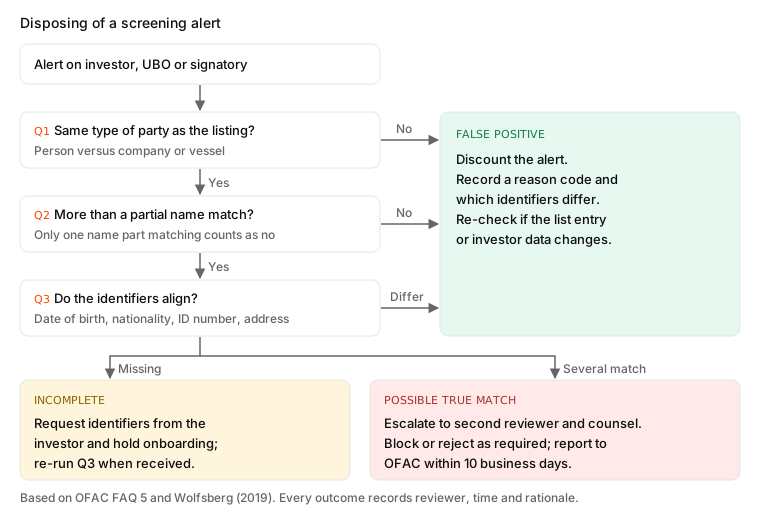
Figure 2. A disposition path for screening alerts, adapted from OFAC FAQ 5. Most alerts close at Q1 to Q3 once intake has captured full identifiers; the reporting deadline applies when property is blocked or a transaction is rejected under OFAC sanctions.
Five operating rules keep the queue manageable without missing real matches:
- Collect identifiers at intake. Date of birth, nationality and ID number resolve most name matches; much queue time goes into chasing data intake should have captured.
- Record a reason for every disposition. Wolfsberg expects reviewers to decide on the data "and, thereafter, record relevant rationale." A reason code plus one sentence is enough.
- Use suppression lists with care. Wolfsberg describes "Good Guys" lists as a way "to manage common false positive alerts." Give each entry an owner and re-check it when either side's data changes.
- Do not tune thresholds to hit a volume target. Loosening fuzzy matching is a risk decision: document it, test it against known matches and name variants, and get sign-off. OFAC's Framework cites failure to account for alternative spellings as a recurring cause of violations.
- Escalate real matches quickly. Under OFAC FAQ 5, if you block property or reject a transaction because of OFAC sanctions, "you must report the action to OFAC within 10 business days."
Where does KYC connect to the rest of the fund stack?
Decide which system is the record for KYC status and documents; everything else should read from it rather than keep copies. Most funds have four integration points, plus payment events.
- Subscription documents and investor portal. The portal should launch KYC for the right investor type and pre-fill name, entity type and commitment. Gate closing on KYC "approved", not "documents received".
- Fund administrator. If your administrator performs investor AML checks, agree who owns the file, who signs off and how status flows back. Two parallel KYC processes for one investor is a common waste.
- CRM. Push status, risk rating and refresh date, not passports or screening hits. The fewer systems holding identity documents, the smaller your privacy exposure.
- Data room. Deal data rooms are built for broad sharing; KYC files can hold biometric data that some US state laws regulate (see biometric privacy and KYC in the US). Keep them separate.
- Payment events. A changed bank account before a distribution, or a transfer of interest, should reopen KYC before money moves.
What does a 30/60/90-day rollout look like?
Spend the first 30 days writing rules, the next 30 piloting on live subscriptions alongside your current process, and the last 30 scaling to every new investor and back-filling existing ones by risk. Figure 3 summarizes the plan.
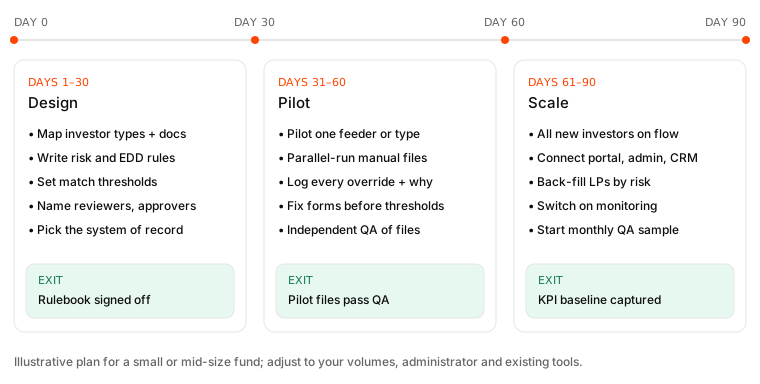
Figure 3. An illustrative 30/60/90-day rollout. Each phase has an exit criterion; do not start the next phase until it is met.
Days 1 to 30: design. List the investor types from your last two closes and the documents each needed. Write the rulebook, name reviewers, approvers and the escalation path to counsel, and decide the system of record and the administrator's role. Exit: a rulebook signed by whoever owns the AML program.
Days 31 to 60: pilot. Route one feeder fund or investor type through the workflow while keeping the manual file in parallel. Compare outcomes case by case and log every override. Fix forms first; change thresholds only with documented sign-off. Exit: pilot files pass independent QA with no material gaps.
Days 61 to 90: scale. Move all new investors across, connect the portal, administrator and CRM, and switch on monitoring. Back-fill existing LPs starting with the highest-risk files. Exit: a KPI baseline and the first monthly QA report.
For a two-person compliance team, this holds only if the rulebook stays short. Choose the vendor before day 1; KYC Software for Investment Funds lists the questions to ask.
Which KPIs should you track?
Track speed, quality and control together, because any one of them alone can be gamed. Speed matters; Fenergo's Financial Crime Industry Trends 2025 survey of 600 senior decision-makers at banks, asset managers and fund administrators found that 70% of firms lost clients in the past year to slow onboarding, with abandonment averaging around 10%. But a fast file that fails QA is no win.
| KPI | Definition | What it tells you |
|---|---|---|
| Time to KYC-complete | Median days from invitation to approval, by investor type | Where entity and trust investors stall |
| First-pass completeness | Share of submissions with no missing items | Whether forms and instructions work |
| Auto-clear rate | Share of files needing no human touch | Efficiency; a very high rate can mean thresholds are too loose |
| Alert rate and false-positive rate | Alerts per 100 parties screened; share discounted | The evidence base for documented tuning |
| Queue age | Items open longer than your internal service level | Reviewer capacity and bottlenecks |
| Override rate | Share of provisional risk ratings changed by reviewers | Whether the scoring rules match judgement |
| QA defect rate | Share of sampled files with a material gap | The control measure an examiner cares about |
| Refresh on time | Share of periodic reviews completed by the due date | Evidence of ongoing due diligence |
Report monthly. A rising override rate, or a falling alert rate after a configuration change, deserves a look first. On speed, see Cutting Time-to-Approval Without Cutting Corners.
What are the most common pitfalls when automating investor KYC?
Most failures come from automating an unclear manual process, not from the software itself.
- Configuring before writing rules. Vendor defaults become your policy by accident.
- Letting the tool approve. No one can explain the decision, and in the EU it fails Article 76.
- Rubber-stamp review. "Meaningful" intervention needs evidence, authority and time to disagree; clearing forty files in ten minutes is not it.
- Screening only the subscriber. Owners, control persons and signatories need screening too.
- Forgetting the existing book. Legacy LPs sit on old files with no monitoring.
- Scattering identity documents across email, the CRM and the data room.
Which regulatory dates should shape your rollout?
Three dates matter: 10 July 2027 for the EU AMLR, January 1, 2028 for the US Investment Adviser AML Rule, and August 2026, when the Corporate Transparency Act was narrowed. OFAC sanctions obligations already apply and wait for none of them.
- EU AMLR: 10 July 2027. Regulation (EU) 2024/1624 applies directly in every member state from that date (Article 90), including Articles 26 and 76.
- US Investment Adviser AML Rule: January 1, 2028. FinCEN's final rule (published January 2, 2026) moved it from January 1, 2026. FinCEN intends to revisit its scope and coordinate with the separate adviser customer identification program (CIP) rulemaking, so identification details may change. Build now and leave room to adjust; see The Investment Adviser AML Rule Moved to 2028.
- Corporate Transparency Act: August 2026. A FinCEN final rule effective August 14, 2026 permanently exempts domestic reporting companies from beneficial ownership reporting. For US LLC investors, your own UBO collection is the only ownership record you will have.
Where Verifica fits
Verifica runs stages 1 to 5 and 9 of the workflow above as one guided flow: smart forms tailored to investor type, government ID and document authenticity checks, biometric liveness, UBO mapping for companies, trusts and fund-of-funds, and sanctions, PEP and adverse-media screening through an integration with LSEG Risk Intelligence, which draws on more than 100,000 credible sources and is used by more than 300 global financial institutions. Investors upload from a phone or laptop.
Anything that needs judgement is flagged to your reviewer, not auto-approved, which maps directly to the human checkpoints in Figure 1. Once checks complete, Verifica generates an exportable, timestamped KYC file in under 60 seconds. Ongoing monitoring is available, with continuous monitoring and enhanced reports priced before activation. Verifica is software, not a law firm: your risk thresholds, policies and sign-off stay with your team.
Frequently Asked Questions
Can investor KYC be fully automated?
Collection, verification, screening and file assembly can be automated end to end, but the decisions should not be. A person should dispose of screening matches, confirm high risk ratings, run enhanced due diligence and approve or reject the investor. In the EU, AMLR Article 76 requires meaningful human intervention in those decisions when automated tools are used.
Which parts of investor KYC should stay manual?
Four decisions should stay with a named person: confirming or overriding a risk rating, deciding whether a sanctions or PEP alert is a true match, conducting enhanced due diligence, and final approval or rejection. Software should prepare the evidence for each, but the reviewer makes the call and the system records who decided, when and why.
How long does it take to automate investor KYC at a small fund?
About 90 days once a tool is chosen: 30 days to write the rulebook and assign reviewers, 30 days to pilot on live subscriptions alongside the manual process, and 30 days to move all new investors across, connect the portal and administrator, and back-fill existing LPs by risk. The plan holds only if the rulebook stays short.
How do you reduce false positives in investor sanctions screening?
Capture date of birth, nationality and ID number at intake so reviewers can discount name-only matches quickly. Follow OFAC FAQ 5: check the party type, how much of the name matches, and whether identifiers differ. Use suppression lists for cleared names, each with an owner, and never loosen matching thresholds without testing and sign-off.
How often should investor KYC be refreshed?
Set the interval by risk and write it into your rulebook. Under the EU AMLR, from 10 July 2027, customer information must be updated at least yearly for higher-risk customers and every five years for others. US rules set no fixed interval for funds today. Events such as an ownership change, new bank account or sanctions alert should trigger an immediate refresh.
Do private fund advisers need automated KYC before 2028?
No rule requires automation. FinCEN's Investment Adviser AML Rule takes effect on January 1, 2028, and its scope may still change. OFAC sanctions obligations already apply, and investors, administrators and auditors expect a documented process. Building the workflow early lets you test rules and train reviewers while mistakes are cheap.
Should the fund administrator or the GP run investor KYC?
Either can, but only one should own each investor file. If your administrator performs AML checks under contract, agree in writing who collects documents, who screens, who signs off and how files come back to you. The manager needs access to the file and the rationale behind each decision. Two parallel processes create conflicting records.
What should an automated investor KYC file contain?
Investor data and documents, ID and liveness results, the ownership chart with beneficial owners and control persons, screening results for every party, each alert disposition with its rationale, the risk rating and any override, EDD notes, and the approval record. Every item should be timestamped and attributed, with the rulebook version that applied.
Sources
- Delaying the Effective Date of the AML/CFT Program and SAR Filing Requirements for Registered Investment Advisers and Exempt Reporting Advisers, final rule, FinCEN, Federal Register doc. 2025-24184, published January 2, 2026.
- 31 CFR 1010.230, Beneficial ownership requirements for legal entity customers, via Legal Information Institute, Cornell Law School.
- Regulation (EU) 2024/1624 on the prevention of the use of the financial system for money laundering or terrorist financing (AMLR), Articles 26, 52, 76 and 90, EUR-Lex, Official Journal of the EU, 2024.
- OFAC FAQ 5: When screening for sanctions, how do I determine if I have a valid match to a name on one of OFAC's lists?, U.S. Treasury, Office of Foreign Assets Control.
- OFAC FAQ 399: the 50 Percent Rule, U.S. Treasury, Office of Foreign Assets Control.
- A Framework for OFAC Compliance Commitments, U.S. Treasury, Office of Foreign Assets Control, May 2019.
- Wolfsberg Guidance on Sanctions Screening, The Wolfsberg Group, 2019.
- FATF Guidance on Digital Identity, Financial Action Task Force (summary published via the Financial Stability Board), March 2020.
- The Money Laundering, Terrorist Financing and Transfer of Funds (Information on the Payer) Regulations 2017, regulation 28, legislation.gov.uk.
- Global financial institutions struggle with rising client losses and compliance costs as AI adoption increases (Financial Crime Industry Trends 2025), Fenergo, October 7, 2025.
- FinCEN Ends Beneficial Ownership Reporting Requirements for U.S. Companies, Morrison Foerster, August 20, 2026.
Rodolfo Santos is a real estate compliance attorney with 10+ years of experience in cross-border transactions and the co-founder of Verifica, an AI-powered compliance platform for real estate professionals. He has closed over 150 property transactions worth more than €50 million.