
How to Reduce Investor Onboarding Time: A Before-and-After Case Study
An illustrative $150M first-time fund with 120 LPs, taken apart stage by stage: where the days actually go, the seven changes that remove most of them, and the parts that stay slow no matter what you buy.

Short Answer
To reduce investor onboarding time, cut waiting time rather than working time. Start KYC when an LP soft-circles instead of after subscription documents arrive, use forms that change by investor type and block incomplete submissions, screen as documents arrive, give reviewers a two-business-day SLA, and use e-signature with scheduled reminders. In our illustrative model of a $150M fund, median entity onboarding falls from about 40 days to about 13.
Key Takeaways
- In a typical manual process, the file is being worked on for only a few hours. Almost all of the elapsed time is queueing between handoffs.
- Rework from not-in-good-order (NIGO) submissions is the single largest block of lost time, so preventing errors at entry beats faster review.
- Running KYC in parallel with legal documents, instead of after them, removes a full stage from the critical path.
- Complex entities, fund-of-funds and true screening hits stay slow. Plan the close date around them, not around the median investor.
- Measure four numbers before changing anything: time-to-approval, touches per investor, first-pass NIGO rate and rework rounds.
This article is the concrete companion to our conceptual piece on cutting KYC time-to-approval. That piece explains the principle. This one runs the numbers on a single fund, stage by stage, so you can see which change buys which days.
What fund is this case study based on?
It is an illustrative composite, not a client. We do not publish customer data, so we built a representative fund and anchored its "before" process to published industry benchmarks. The "after" numbers are modelled estimates with stated assumptions, not results anyone has achieved.
The composite is a $150M first-time private fund raising from 120 LPs ahead of a first close. The LP mix looks like many emerging-manager raises:
| Investor type | Count | What makes them slow |
|---|---|---|
| Individuals (including joint accounts and IRAs) | 78 | Missing pages, accreditation boxes left blank, expired ID |
| Operating entities, LLCs, trusts, family offices | 30 | Beneficial ownership disclosure, authorized signatory evidence, trust deeds |
| Institutional LPs and fund-of-funds | 12 | Their own legal review, layered ownership, side letters |
The baseline is grounded in these published figures:
- Fund close delays. In IQ-EQ's survey of more than 50 fund managers (published April 2026), 74% of GPs said KYC adds six to 30 days to fund closing timelines, and 48% still run KYC on spreadsheets and email.
- Onboarding duration. Fenergo's 2025 survey of 600 senior decision-makers at banks, asset managers and fund administrators found UK corporate banks average more than six weeks to onboard a client. An older Thomson Reuters survey (2017) put investment managers at 23 days on average.
- Touches. The same Thomson Reuters survey found institutions believe they contact a client four times during onboarding, while corporate clients report being contacted eight times.
- Errors on first submission. Passthrough, a subscription-document vendor, states that historically only 20% of subscription documents are in good order when first submitted. Treat that as a vendor-reported figure, but it matches what most fund operations teams describe.
- Lost investors. Fenergo reports that 74% of tier 1 asset managers have lost a client to slow onboarding (2024) and that average onboarding abandonment sits around 10% (2025).
How long does investor onboarding take before anything changes?
In the baseline, a median entity LP takes about 40 calendar days from receiving the subscription packet to compliance sign-off, and a median individual about 21 days (illustrative). Those figures sit inside the six-to-30-day delay range GPs report to IQ-EQ and below Fenergo's six-week figure for UK corporate onboarding.
The baseline process is sequencial. Legal sends the subscription packet, KYC only starts once the packet comes back. Screening only starts once KYC documents are complete. Here is the median entity LP:
| Stage | Days (illustrative) | What happens | Who is waiting |
|---|---|---|---|
| 1. Invite to first response | 0 to 6 | PDF packet emailed; LP opens it when they get to it | Fund |
| 2. LP assembles packet | 6 to 15 | LP prints, fills, finds formation documents and IDs for owners, scans | Fund |
| 3. Intake queue and NIGO check | 15 to 18 | Ops checks completeness; four in five packets have a defect | LP |
| 4. Rework (average two rounds) | 18 to 30 | Email listing missing items, LP replies days later, a second gap appears | Both |
| 5. Screening, UBO and review | 30 to 35 | Sanctions and PEP screening run only now; reviewer clears alerts in batch | LP |
| 6. Signature and countersignature | 35 to 40 | Wet-ink or scanned signature pages, GP countersigns at month end | LP |
Two features of this table drive everything that follows. First, stage 4 is the longest stage and exists only because stage 2 lets errors through. Second, stage 5 cannot start until stage 4 ends, even though screening a name does not depend on whether page 14 of the subscription agreement is initialed.
Where do the days go: waiting or working?
Almost entirely waiting. In the composite, the hands-on work on a median entity file (by the LP, the fund's operations team and the compliance reviewer combined) is about 9.5 hours, spread across roughly 28 business days. That is around 4% of the elapsed time.
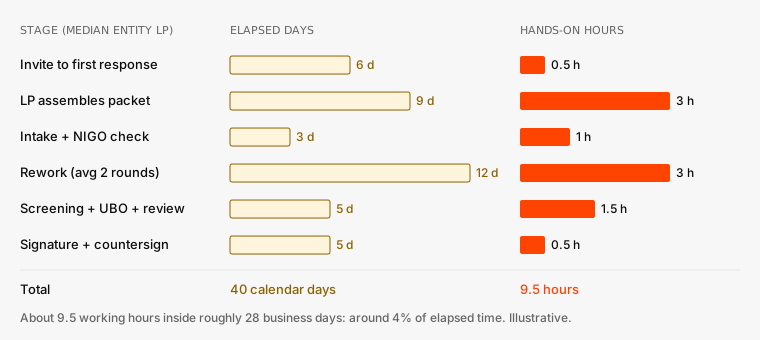
Figure 1. Elapsed days versus hands-on hours for a median entity LP in the baseline process. Illustrative composite: stage durations are calibrated to the published ranges cited in this article; hours are our estimates, not measured data.
This is the most useful single insight in the exercise. If you hire another analyst, you speed up 9.5 hours of work and leave 39 days of queueing intact. The fixes that matter remove handoffs, prevent rework and let stages overlap.
Where investors stall
Looking at all 120 LPs at a single point in time shows where the queue builds. Four weeks after packets go out, the baseline fund has fewer than half its LPs approved and, the largest group is stuck in rework.
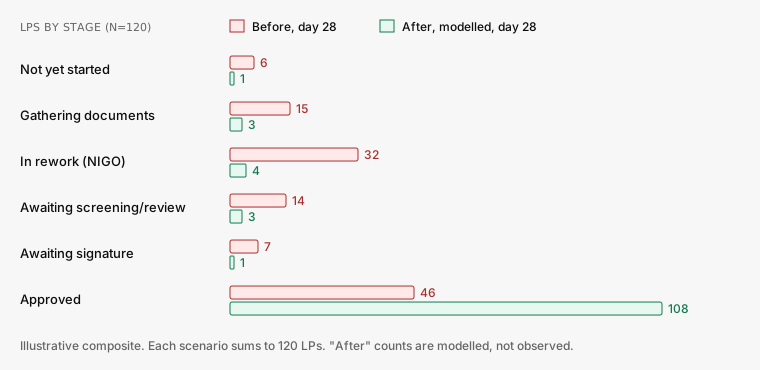
Figure 2. Where the composite fund's 120 LPs sit 28 days after invitation. The baseline backlog concentrates in rework and the screening queue. Illustrative: the "after" distribution is a model output based on the assumptions listed below.
What changes cut investor onboarding time?
Seven changes, each aimed at a specific stage. None of them lowers the compliance standard: the same documents are collected and the same person signs off. What changes is when work starts, how errors are caught and how long a file can sit untouched.
- Pre-close KYC. Send the KYC invitation when an LP soft-circles a commitment, not when the executed subscription agreement comes back. Identity, ownership and screening do not depend on the final legal terms, so they can run while counsel is still negotiating side letters. This removes most of stage 1 from the critical path and lets stage 5 overlap stage 2. Practical limit: if your administrator or placement agent requires the full packet before opening a file, agree the sequence with them first.
- Investor-type smart forms. One generic packet asks an individual for a trust deed and forgets to ask an LLC for its operating agreement. A form that branches on investor type (individual, joint, IRA, LLC, trust, partnership, fund-of-funds) asks only for what applies. For entities it should collect every individual who owns 25% or more and one control person, the structure set out in FinCEN's CDD rule at 31 CFR 1010.230, which many fund programs use as their benchmark even where it does not bind them directly. Our LP document checklist by investor type lists the items.
- NIGO prevention at entry. Required fields cannot be skipped, accreditation status must be selected, expiry dates are checked on upload, and the signatory named must match the authorized-signatory evidence. Every defect caught in the form is a rework round that never starts. This is the change with the largest effect in the model.
- Parallel screening. Run sanctions, PEP and adverse-media screening on each person and entity the moment their details are entered, rather than in a batch after the file is complete. Alerts land in the reviewer's queue while the LP is still uploading. For what the screening has to cover, including OFAC's 50 Percent Rule for owned entities, see our guide to OFAC screening for U.S. private funds.
- Digital signature. Under the federal ESIGN Act, 15 U.S.C. 7001(a), a signature or contract in interstate commerce may not be denied legal effect solely because it is electronic. Check your fund documents and any non-U.S. LP's local requirements, but for most U.S. subscriptions e-signature removes the print-sign-scan loop and the month-end countersignature batch.
- Reviewer SLAs and a named owner. Commit to clearing a complete file within two business days and give each LP one named onboarding owner. Alter Domus lists both a single onboarding owner per LP and shared onboarding SLAs among its fund onboarding practices (February 2026). The SLA turns review from a weekly batch into a queue someone is accountable for.
- Scheduled reminders, then a human. Automated reminders on fixed days (in the model: days 2, 5 and 9), each listing exactly what is outstanding, followed by a call from investor relations on day 10. Reminders that name the missing item get answered; "please complete your onboarding" does not. Our piece on boosting KYC response rates covers message design.
What does the onboarding timeline look like after the changes?
In the model, median entity onboarding falls from about 40 days to about 13, and median individual onboarding from about 21 days to about 6. Most of the gain comes from two places: rework shrinks from 12 days to 3, and screening moves off the critical path entirely.
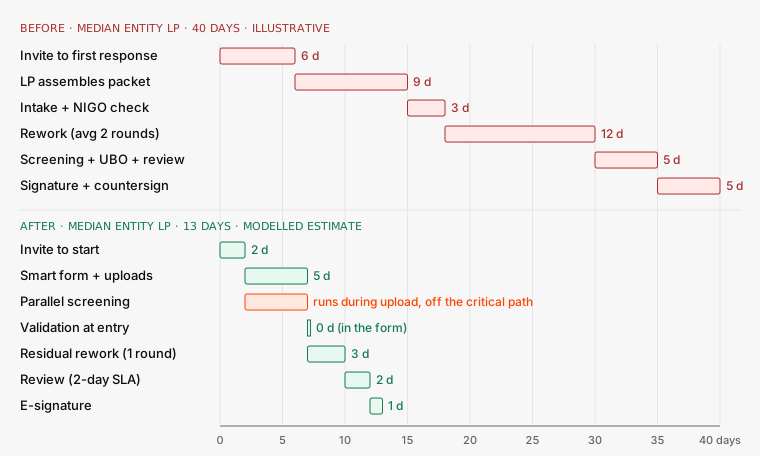
Figure 3. Before and after timeline for a median entity LP in the composite fund. Illustrative: the baseline is calibrated to published benchmarks; the "after" timeline is a modelled estimate under the assumptions below, not an observed result.
| Metric (composite fund) | Before (illustrative) | After (modelled) |
|---|---|---|
| Median time-to-approval, individuals | 21 days | 6 days |
| Median time-to-approval, entities | 40 days | 13 days |
| Median time-to-approval, institutional and fund-of-funds | 55 days | 41 days |
| First-pass NIGO rate | 80% | 25% |
| Average rework rounds per LP | 2.0 | 0.3 |
| Outbound touches per entity LP | 8 | 4 (3 automated) |
| Hands-on hours per entity LP | 9.5 | About 4 |
| LPs approved at day 28 | 46 of 120 | 108 of 120 |
The model rests on these assumptions. Change any of them and the "after" numbers move:
- First-pass NIGO of 25%. Deliberately more conservative than the 80%+ in-good-order rate Passthrough claims for its own platform. Remaining defects are things a form cannot check, such as a trust deed that turns out to be superseded.
- KYC invitations go out at soft-circle, a median of 10 days before the subscription agreement would otherwise have come back.
- Reviewers meet a two-business-day SLA on 90% of complete files.
- Screening alerts are mostly false positives cleared within the same SLA. True matches go to enhanced due diligence and are excluded from the median.
- Touches follow the Thomson Reuters client-side figure of eight for the baseline, and the reminder cadence above plus one human call for the "after" case.
What did not get faster, and why?
The long tail. Institutional LPs and fund-of-funds only improve from about 55 to about 41 days in the model, and the 90th-percentile LP barely moves. That matters because the slowest investors you need for a close, not the median one, set the closing date.
- Layered ownership. A fund-of-funds or trust-within-LLC structure needs ownership traced through each layer to natural persons. Forms make the request clearer but cannot make a third-party administrator in another time zone reply faster. Our guide to untangling ultimate beneficial ownership covers the method.
- The LP's own process. Institutional investors route subscriptions through their own counsel, investment committee and signatory policies. None of that sits in your workflow.
- True screening hits. A genuine PEP or sanctions-adjacent match triggers enhanced due diligence and source-of-wealth review. That should take as long as it takes. A faster process that clears it in two days is a weaker process, not a better one.
- Non-response. Some LPs simply go quiet. Reminders reduce this but do not eliminate it, and Fenergo's roughly 10% average abandonment rate across financial institutions is a reminder that some investors will not finish at all.
- Policy decisions. Whether to accept a certified copy, whether a 20% owner needs full verification in a higher-risk structure: these are judgement calls for your compliance lead, and software should route them, not make them.
The practical response is to identify long-tail LPs on day one (every fund-of-funds, every multi-layer entity, every non-U.S. institution) and start them first, with a named owner and a direct line to their administrator.
Regulation will not shorten this tail either. FinCEN's AML program rule for registered and exempt reporting advisers now takes effect on January 1, 2028, after a final rule published on January 2, 2026 delayed it two years, and FinCEN has said a separate customer identification program rule for advisers will be handled in a joint rulemaking with the SEC. Our article on the 2028 adviser AML rule covers what to build now.
How do you measure your own onboarding baseline?
Pull timestamps for 20 to 30 LPs from your last close and calculate four numbers. You cannot tell which of the seven changes will pay off until you know where your own days go.
Measure Your Baseline
- Time-to-approval. Calendar days from invitation sent to compliance sign-off. Report the median and the 90th percentile, split by investor type.
- Touches per investor. Count every outbound request for information or signature, from email, calls and portal messages. Count from the LP's side, not your team's memory.
- First-pass NIGO rate. Share of first submissions with at least one defect that needs the LP to act.
- Rework rate. Average number of return-to-LP rounds per investor, and the days each round adds.
- Optional: waiting share. For five files, log hands-on minutes per stage and divide by elapsed time. Expect a single-digit percentage.
A spreadsheet with six timestamp columns per LP (invited, first response, first submission, in good order, screening cleared, approved) is enough. Most of the data already sits in your email and document folders.
Checklist: how to reduce investor onboarding time
Work through this in order. The early items cost little and remove the most days.
- Measure the four baseline numbers above for your last close.
- Tag every expected LP by investor type and flag long-tail structures on day one.
- Send KYC invitations at soft-circle, in parallel with legal documents.
- Replace the generic packet with forms that branch by investor type.
- Make required fields, accreditation selection and signatory evidence mandatory before submission; check ID expiry on upload.
- Screen each person and entity as they are entered, not after the file is complete.
- Assign one named onboarding owner per LP.
- Set and publish a reviewer SLA for complete files, and track breaches weekly.
- Schedule reminders that name the missing item, then escalate to a call.
- Use e-signature for subscription documents and countersignature where your documents and the LP's jurisdiction allow it.
- Keep a timestamped record of every request, upload, screening result and decision so speed does not cost you an exam-ready audit trail.
- Re-measure after the next close and compare against the baseline.
Where Verifica fits
Verifica covers changes 2, 3, 4 and most of 7 in one guided flow. Investors get smart forms tailored to their type and upload from phone or laptop. Government ID and document authenticity checks, biometric liveness, sanctions, PEP and adverse-media screening through an integration with LSEG Risk Intelligence, and UBO mapping for companies, trusts and fund-of-funds all run in the same workflow. Anything needing judgement is flagged to a human reviewer rather than auto-approved.
Once checks complete, Verifica generates a compliant KYC file in under 60 seconds, with a timestamped, exportable audit trail. Ongoing monitoring is available after onboarding. Verifica is software, not a law firm: your risk thresholds, policy and sign-off stay with your team, and the long-tail limits described above apply to any tool, ours included.
Frequently Asked Questions
How long does investor onboarding usually take?
It depends heavily on investor type. Published surveys give a range: 74% of GPs in a 2026 IQ-EQ survey said KYC adds six to 30 days to fund closing timelines, and Fenergo found UK corporate banks average more than six weeks per client. In our illustrative composite, a manual process takes about 21 days for an individual LP and about 40 days for an entity.
What is the fastest way to reduce investor onboarding time?
Prevent not-in-good-order submissions. Rework rounds are usually the longest single stage, because each one means an email, a wait for the investor, and a fresh review. Forms that branch by investor type and refuse incomplete submissions remove most of that loop. Starting KYC at soft-circle, in parallel with legal documents, is the second biggest lever.
What does NIGO mean in investor onboarding?
NIGO stands for not in good order. A subscription or KYC submission is NIGO when it cannot be processed as received: a missing signature page, a blank accreditation section, an expired ID, or ownership information that does not reconcile. The first-pass NIGO rate is the share of initial submissions with at least one such defect.
Can KYC start before the subscription agreement is signed?
Usually yes. Identity verification, beneficial ownership collection and sanctions screening do not depend on final legal terms, so many funds start them when an investor soft-circles a commitment. Confirm the sequence with your fund counsel, administrator and any placement agent, since some require the full packet before opening a file, and do not accept funds until checks are complete.
Are electronic signatures valid on fund subscription documents?
For most U.S. transactions, yes. The ESIGN Act, 15 U.S.C. 7001(a), provides that a signature or contract in interstate commerce may not be denied legal effect solely because it is electronic. Check your fund documents for any wet-ink requirement and confirm local rules for non-U.S. investors, which vary by jurisdiction.
Which investors take longest to onboard, and why?
Fund-of-funds, multi-layer entities and institutional LPs. Their ownership has to be traced through several layers to natural persons, often via a third-party administrator, and their own counsel and investment committee add steps outside your control. Identify them on day one, start them first and assign a named owner rather than waiting for the general reminder cycle.
Will the 2028 investment adviser AML rule slow onboarding down?
It may add formal requirements, but it should not lengthen a well-designed process much. FinCEN's AML program rule for advisers takes effect on January 1, 2028, and a separate adviser customer identification rule is still being developed with the SEC. Funds that already collect structured identity and ownership data and screen in parallel will mostly be documenting work they already do.
How do I measure investor onboarding time?
Record six timestamps per LP: invited, first response, first submission, in good order, screening cleared and approved. From those, calculate median and 90th-percentile time-to-approval by investor type, touches per investor, first-pass NIGO rate and rework rounds. Twenty to thirty LPs from your last close are enough to see where the days go.
Sources
- From back-office formality to front-line differentiator: five key findings from our fund managers' KYC survey, IQ-EQ, April 30, 2026.
- Know your customer and keep them happy: KYC challenges and opportunities for private markets fund managers, IQ-EQ, March 16, 2026 (updated June 2, 2026).
- Global financial institutions struggle with rising client losses and compliance costs as AI adoption increases, Fenergo, October 7, 2025.
- Fenergo report says 70% of banks lost clients to onboarding delays in 2025, Fintech News Singapore, October 2025.
- Global KYC Trends in 2024 for Asset Management, Fenergo, 2024.
- KYC pain: financial institutions and their clients still struggling with ongoing challenges (Thomson Reuters 2017 Global KYC Surveys), The Global Treasurer, November 2, 2017.
- Automate your investor onboarding, Passthrough (vendor page, accessed October 2026).
- Accelerating fund onboarding: 7 best practices to impress new LPs, Alter Domus, February 4, 2026.
- 31 CFR 1010.230, Beneficial ownership requirements for legal entity customers, Legal Information Institute, Cornell Law School.
- 15 U.S.C. 7001, General rule of validity (ESIGN Act), Legal Information Institute, Cornell Law School.
- FinCEN finalizes two-year delay of the investment adviser AML rule, Proskauer Rose LLP, January 2026.
Rodolfo Santos is a real estate compliance attorney with 10+ years of experience in cross-border transactions and the co-founder of Verifica, an AI-powered compliance platform for real estate professionals. He has closed over 150 property transactions worth more than €50 million.