
How to Manage KYC Across Multiple Funds: One Investor Record, Many Fund Files
An operating model for administrators and multi-fund managers: who is accountable where, when prior KYC can be reused, how to keep clients apart, and how to screen once across the whole book.

Short Answer
Manage KYC across multiple funds by verifying each investor once in a master record (identity, beneficial ownership, screening, core risk rating) and linking it to a separate file for every fund they enter. Each fund file holds that fund's subscription, source of funds, jurisdiction-specific top-ups and sign-off. Reuse the master record only under a documented reliance or delegation basis, refresh it on risk and events, and screen once across the book.
Key Takeaways
- Accountability does not move with the work. Cayman, the EU, Ireland, the UK and FinCEN's 2028 adviser rule all leave the fund or adviser responsible.
- Reliance (accepting another regulated firm's checks) differs from delegation (a provider runs your procedures). Ireland bars reliance for ongoing monitoring and EDD.
- Beneficial ownership thresholds differ: 25% or more in the US CDD rule and the EU AMLR, more than 25% in the UK and Luxembourg, and no fixed number in CIMA's Guidance Notes.
- Cayman's new compliance programme and sanctions rules took effect on 18 September 2026 and require rescreening existing investors without delay when sanctions lists change.
- Deduplicate inside one client's fund family, never silently across clients.
What Does Managing KYC Across Multiple Funds Involve?
It means running investor due diligence for many legal vehicles at once, often for several GP clients, without repeating checks or losing track of which fund relied on what. The hard part is not verifying a passport. It is the bookkeeping of responsibility.
Take a sponsor with Fund I (a Delaware LP), Fund II with a Cayman parallel vehicle, a Luxembourg SCSp feeder and several co-invest SPVs. A family office invests in four of those vehicles. Handled per fund, it is onboarded four times, its trust deed sits in four folders, and its owners are screened on four schedules. When one settlor becomes a PEP, the update reaches one file and not the other three.
The fix is structural: separate what is true about the investor from what is true about its position in each fund, and document the legal basis for sharing between them. For the single-fund workflow, see How to Automate KYC Document Collection and Sanctions Screening for New LPs. This article covers the layer above it.
Who Is Responsible for KYC When an Administrator Does the Work?
The fund is, or the adviser in the US from 2028. Every regime covered here lets the administrator do the work; none lets the fund hand over the accountability.
- Cayman. CIMA's Rule on Effective Compliance Programme (effective 18 September 2026) says a provider relying on a third party "shall retain ultimate responsibility for such compliance." The Guidance Notes add that a fund and its administrator each have separate obligations to maintain AML procedures.
- EU. Regulation (EU) 2024/1624 (the AMLR, applying from 10 July 2027) keeps the obliged entity "fully liable" for outsourced tasks (Article 18(2)) and leaves "ultimate responsibility" with the entity that relies on another (Article 48(1)).
- Luxembourg. Article 3-3 of the Law of 12 November 2004 allows reliance, but final responsibility stays with the professional relying.
- Ireland. Section 40(5) of the Criminal Justice (Money Laundering and Terrorist Financing) Act 2010 keeps a relying firm liable, and the Central Bank of Ireland's guidelines say the same for outsourcing.
- UK. Regulation 39(1) of the Money Laundering Regulations 2017: the relying person "remains liable for any failure to apply such measures."
- US. FinCEN's investment adviser rule, now effective January 1, 2028, lets advisers delegate to fund administrators, but the adviser remains fully responsible and must demonstrate compliance to examiners. OFAC sanctions already apply to all U.S. persons.
Named roles sit on top. A Cayman fund must designate natural persons at managerial level as AMLCO, MLRO and DMLRO; CIMA's AML FAQs for funds allow independent staff of the administrator or manager to fill them, and the MLRO and DMLRO must be different people. A Luxembourg fund needs an RR (the board or a member) and an RC mandated personally by the board, per the CSSF FAQ. An administrator employee who is MLRO for thirty funds answers to thirty boards, and the operating model has to make that workable.
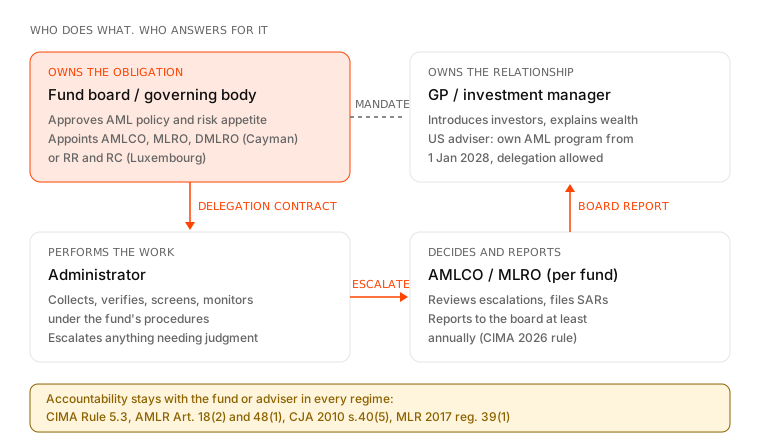
Figure 1. The administrator does most of the work; the obligation, named officers and board reporting line belong to each fund.
How Do KYC Requirements Differ by Fund Jurisdiction?
The principles match, but the working details differ: who must be named, which ownership threshold applies, what you may rely on, and how fast a relied-upon party must produce documents. The table covers the regimes a typical administrator meets, plus the EU AMLR that replaces national rules in Luxembourg and Ireland from 10 July 2027.
| Regime | Who must be named | Beneficial owner threshold | Reliance and delegation | Refresh and monitoring |
|---|---|---|---|---|
| US (Delaware funds) | No adviser AML officer until the IA AML rule applies on 1 Jan 2028 | 25% or more plus one control person (31 CFR 1010.230; binds banks and broker-dealers, a common benchmark) | 1010.230(j): reasonable reliance on a BSA-regulated institution with annual certification. IA rule: delegation allowed, adviser fully responsible | FIN-2026-R001: beneficial owners at first account, then on doubt or per risk procedures |
| Cayman Islands | AMLCO, MLRO, DMLRO (natural persons; MLRO and DMLRO differ) | No fixed percentage: ownership, then other control, then senior managing official | Eligible introducers (AMLRs reg. 25) with written assurance and copies without delay. Material outsourcing notified to CIMA | Review by risk rating; rescreen without delay on sanctions list updates |
| Luxembourg | RR and RC, for each fund and each manager | More than 25% indicates ownership (Law of 12 Nov 2004, art. 1) | Art. 3-3: reliance if information is available immediately; responsibility stays with the fund | Risk-based; AMLR limits from July 2027 |
| Ireland | Roles under CJA 2010 and CBI guidelines | 4AMLD definition via CJA 2010 s.26 (same 25% indicator) | s.40: consenting, supervised third party only; never for EDD or senior approval | Ongoing monitoring cannot be relied on |
| United Kingdom | Roles under MLR 2017 | More than 25% of shares or votes (reg. 5) | Reg. 39: relying person liable; copies immediately on request | Ongoing, frequency set by risk |
| EU AMLR (from 10 Jul 2027) | Set by the AMLR | 25% or more (Art. 52); for funds, 25% of units or influence over investment policy (Art. 61) | Art. 48 to 49: copies within 5 working days, written agreement. Art. 18: core decisions not outsourceable, except funds with supervisor approval (Art. 18(7)) | Update at least every 1 year (higher risk) or 5 years (others), and on change (Art. 26(2)) |
Two rows deserve emphasis. Ireland's reliance is narrow: firms "cannot rely on the third party to perform the EDD measures or provide senior management approval," says the Central Bank. And AMLR Article 18(7) is written for funds: a fund without legal personality, or with only a board that has delegated subscription processing, may outsource customer risk and onboarding decisions once the supervisor approves. Put that approval on the 2027 plan.
See also Cross-Border KYC for multi-country documents and Delaware, Wyoming, and Nevada for US entities that hide owners.
Should You Keep One Investor Master Record or a File per Fund?
Both. Keep one master record per investor per client relationship, and a fund file for each vehicle that links to it. The master record holds facts about the investor, the fund file holds facts about the investment and the funds decision.
- Master record: verified identity of the investor and each beneficial owner and controller; ownership chart; PEP status; screening history and open alerts; core risk factors; document expiry dates; refresh due date.
- Fund file: subscription documents; source of funds for this commitment and the remitting bank; jurisdiction top-ups; the reliance or delegation basis used; the fund's risk rating; sign-off by that fund's responsible person.
This split fixes the PEP-settlor problem: the status changes once and every linked fund's officer gets a task to reassess. It also helps at redemption. CIMA's guidance says proceeds should go only to the investor, and where due diligence is outstanding, payment should wait until it is collected and verified. A master record shows that status across every fund the investor holds.
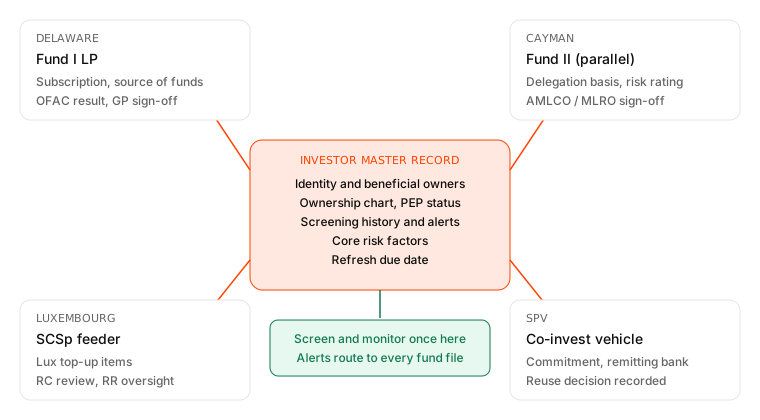
Figure 2. Hub-and-spoke model: investor facts live once in the master record; each fund file records the investment, the basis for reuse and the fund's decision.
When Can Prior KYC Be Reused for a New Fund, and When Must It Be Refreshed?
Prior KYC can be reused when three things are true: the new fund has a legal basis to use it, the file is inside its refresh window, and nothing has called it into question. If any one fails, refresh the affected elements before accepting the subscription.
The legal basis matters because each fund is usually its own obliged entity. Common bases: delegation (one administrator working under procedures each fund has adopted), reliance on a regulated third party, and group arrangements. CIMA's guidance says identity need not be re-verified where a group entity verified it compatibly and confirms in writing that records will be provided on request, and AMLR Article 48(3) allows group reliance on similar terms.
US regulators have moved toward reuse too. FinCEN's exceptive relief order FIN-2026-R001 (February 13, 2026) lets banks and broker-dealers identify a legal entity customer's beneficial owners at the first account, then again only when facts call the information into question or risk procedures require it. The consolidated CDD FAQs (May 2026) allow reuse if the customer confirms the information is current and the confirmation is recorded. That does not bind private fund advisers today, but it is a sound template for a fund family: confirm, record, rescreen.
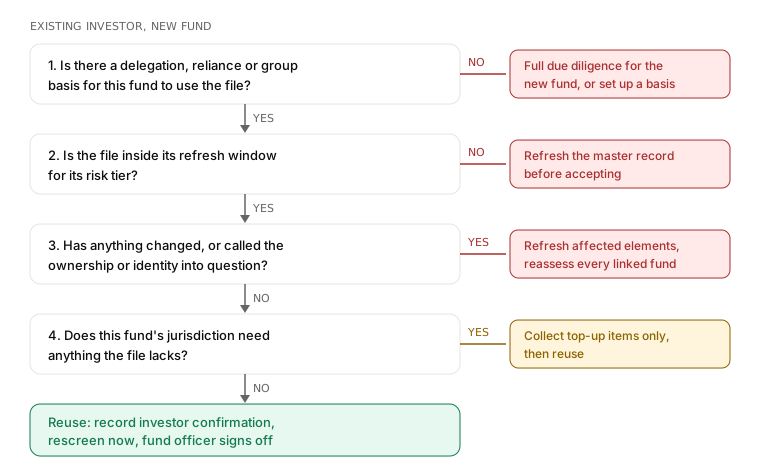
Figure 3. Reuse-or-refresh decision for a returning investor. Refresh windows are your policy, within AMLR Article 26 limits from July 2027.
Refresh triggers to write into policy:
- The refresh date for the risk tier has passed, or an ID document has expired.
- Ownership, controllers or signatories have changed.
- A screening hit, new PEP status or credible adverse media.
- Money from an unexpected bank, country or third party, or a redemption to an account not in the investor's name.
- The new fund's jurisdiction or risk profile is stricter than the one the file was built for.
How Do You Keep Client Data Segregated and Access Controlled?
Treat each GP client as a separate tenant and each fund as a permission boundary inside it. Deduplicate within a client's fund family; do not merge investors across clients.
A pension plan investing with three sponsors you administer is three customers. Each sponsor's funds are separate obliged entities with their own confidentiality terms, and data protection law (GDPR in the EU and UK) limits reusing personal data collected for one controller's purpose for another. If an investor asks you to reuse documents across sponsors, record its consent and have the receiving fund set up its own basis to rely.
Inside a client, set access by role and fund. Analysts see the funds they work on; each fund's MLRO or RC sees that fund's files and linked master records; the GP sees status and outcomes, not suspicion analysis. Restrict SAR-related notes to the MLRO function because tipping-off rules apply, and log every view and export. CIMA's 2026 rule bars outsourcing arrangements where confidentiality or data protection limits could impede the Authority's access, so you must be able to show who holds what.
How Do You Apply One Risk Methodology Across Funds?
Use one scoring core for every fund and add jurisdiction overlays. The core makes ratings comparable across the book; the overlays keep each fund compliant with its own rules.
The core scores investor type, geography, PEP status, adverse media, ownership complexity, source of wealth and channel, the themes CIMA's fund guidance also names. Overlays adjust per fund: a Cayman fund may rate an investor low risk only if that is consistent with the National Risk Assessment or CIMA's latest findings; an Irish fund cannot rely on a third party for EDD; an AMLR fund needs refresh intervals within Article 26.
Two rules keep this honest. The master record carries the highest rating any linked fund assigns, so the same family office cannot be high risk in Cayman and low risk in Delaware. And the methodolgy belongs to the funds: AMLR Article 18(3) makes approval of policies and the business-wide risk assessment non-outsourceable, and CIMA's rule puts the governance framework on the governing body.
How Do You Run Screening and Monitoring Once Across the Book?
Screen every person in every master record (investors, beneficial owners, controllers, signatories) as one population, then route each alert to every fund that person touches. One name, one investigation, and each fund records its own decision.
Cayman now defines the speed. CIMA's Rule on Compliance with Financial Sanctions, effective 18 September 2026, requires existing customers and connected persons to be screened "without delay" when a sanctions list is updated, ideally within hours of a UN designation. For US funds, ownership data matters as much as names; see OFAC Sanctions Screening for U.S. Private Funds.
Book-level monitoring also catches what no single fund sees, such as one remitting account funding unrelated investors or one controller behind several "unrelated" entities. AMLR Article 26(1) points the same way, requiring group entities to consider a customer's other group relationships when monitoring.
What Should You Report to Each GP Client?
Report what each fund's board needs to discharge its responsibility, per fund and in a consistent format. A board that cannot see the work cannot show a regulator it oversees it.
- Onboarding pipeline: pending investors, ageing and blockers.
- Risk distribution, with high-risk and PEP relationships listed.
- Screening: alerts raised, cleared, escalated and overdue.
- Refresh: files due and overdue by tier.
- Reliance and delegation: parties relied on and the last document-retrieval test.
- Exceptions, and who approved them.
Suspicious activity stays out of the general pack and goes through the MLRO. The pack feeds the AMLCO's board report, required at least annually under CIMA's 2026 rule. Keep each pack as an exportable record; AML Audit Trails covers what examiners expect.
What Operating Model Works: Roles, Queues and SLAs?
Organize around queues, not clients. Analysts work shared queues across the book while each fund keeps a named reviewer and officer, which gives scale without blurring accountability.
| Role | Owns | Example target (illustrative) |
|---|---|---|
| Onboarding analyst | New investor and new fund queues; first-line risk score | File to review within 2 business days of last document |
| Screening analyst | Alert queue across the book | Sanctions alerts triaged same business day |
| Senior reviewer / QA | Medium and high-risk files, reuse decisions, QA samples | Review within 2 business days |
| Fund AMLCO / MLRO / RC | Fund approvals, escalations, SARs, board reporting | Escalations decided within 5 business days |
| Client service lead | GP communication, chasers, reporting packs | Pack within 10 business days of period end |
Run five queues: new investor, existing investor in a new fund, alerts, refresh and escalations, each item tagged with client, fund and jurisdiction. Then test the arrangement as regulators expect: Ireland wants regular testing that relied-upon documents can be retrieved without undue delay, the AMLR sets 5 working days for copies under reliance, and CIMA expects a fund to satisfy itself regularly that its delegate's systems are reliable.
How Verifica Supports a Multi-Fund KYC Operation
Verifica runs the investor-level work in one guided flow: ID and document authenticity checks, biometric liveness, sanctions, PEP and adverse-media screening powered by LSEG Risk Intelligence, and beneficial ownership mapping for companies, trusts and fund-of-funds. Smart forms adapt to the investor type, and investors upload from a phone or laptop.
Once checks complete, Verifica generates a timestamped, exportable KYC file in under 60 seconds, which can be attached to each fund file. Anything that needs judgment is flagged to a human reviewer rather than auto-approved, and ongoing monitoring is available (continuous monitoring and enhanced reports are priced before activation). Verifica is software, not a law firm: each fund's risk thresholds, policy and sign-off stay with your team and its officers.
Frequently Asked Questions
Do we need to redo KYC for every fund an investor joins?
Not usually. Identity, beneficial ownership and screening can be reused if the file is within its refresh date, nothing has changed, and the new fund's jurisdiction adds no missing requirement. Each fund still records its own decision: subscription, source of funds, a fresh screening result and sign-off. Where the new fund is a separate obliged entity, reuse needs a reliance or delegation basis, not just a shared folder.
Who is responsible for KYC when the fund administrator does it?
The fund, and in the US from 2028 the adviser. CIMA's 2026 rule says a provider relying on a third party retains ultimate responsibility. The EU AMLR keeps the obliged entity fully liable for outsourced tasks, Ireland's CJA 2010 section 40(5) keeps the relying firm liable, and FinCEN's adviser rule allows delegation while the adviser remains fully responsible. The administrator answers to its client under contract.
Can a Cayman fund appoint someone at its administrator as MLRO?
Yes. CIMA's AML FAQs for funds say an independent person employed by a service provider, such as the administrator or investment manager, may be appointed MLRO or DMLRO. The fund must designate natural persons at managerial level as AMLCO, MLRO and DMLRO, and the MLRO and DMLRO must be different people. One person may hold both AMLCO and MLRO roles if competent and with enough time.
What is the difference between reliance and delegation in fund KYC?
Under reliance, another regulated firm performs due diligence under its own procedures and you accept the result, with a right to copies on request. Under delegation or outsourcing, a provider performs the work under your procedures and control. CIMA's Guidance Notes draw this line. The Central Bank of Ireland adds that reliance cannot cover ongoing monitoring, enhanced due diligence or senior management approval.
How often should investor KYC be refreshed across funds?
On risk and on events. From 10 July 2027, Article 26 of the EU AMLR caps the gap between updates at 1 year for higher-risk customers and 5 years for others, with updates on any relevant change. Many administrators apply that cadence across the book. Sanctions screening runs faster: CIMA's 2026 sanctions rule requires rescreening existing customers without delay when a list is updated.
Can an administrator share an investor's KYC between two different GP clients?
Not by default. Each client's funds are separate obliged entities with their own confidentiality terms, and data protection law limits reusing personal data for another controller's purpose. Keep a separate investor record per client. Reuse across clients only where the investor consents or resubmits and the receiving fund has a documented basis to rely. Deduplication belongs inside one client's fund family.
Does the 2028 FinCEN investment adviser rule change how US funds use administrators?
It formalizes the arrangement. From January 1, 2028, covered RIAs and exempt reporting advisers need an AML/CFT program and must file SARs. Advisers may contractually delegate parts of the program to fund administrators but remain fully responsible and must demonstrate compliance to examiners. FinCEN has said it may revise the rule first and is revisiting the adviser CIP proposal with the SEC.
For the full timeline and build plan, see The Investment Adviser AML Rule Moved to 2028. For choosing tools, see KYC Software for Investment Funds.
Sources
- 31 CFR 1010.230, Beneficial ownership requirements for legal entity customers (Legal Information Institute, Cornell Law School, accessed October 2026).
- Exceptive Relief from Requirement to Identify and Verify Beneficial Owners at Each Account Opening, FIN-2026-R001 (FinCEN, February 13, 2026).
- Customer Due Diligence Rule: Consolidated Frequently Asked Questions (FinCEN, May 2026).
- Treasury Announces Postponement and Reopening of Investment Adviser Rule (U.S. Department of the Treasury, July 21, 2025).
- FinCEN Finalizes Two-Year Delay of the Investment Adviser AML Rule (Proskauer Rose, January 14, 2026).
- What To Know About FinCEN's Investment Adviser AML Program Final Rule (Davis Wright Tremaine, October 7, 2024).
- Basic Information on OFAC and Sanctions, FAQ 11 (OFAC, U.S. Department of the Treasury, accessed October 2026).
- Guidance Notes on the Prevention and Detection of Money Laundering, Terrorist Financing and Proliferation Financing in the Cayman Islands (CIMA, February 2024).
- AML FAQs for Funds (CIMA, accessed October 2026).
- Rule: Effective Compliance Programme for the Prevention and Detection of Money Laundering, Terrorist Financing and Proliferation Financing for Financial Services Providers (CIMA, July 2026, effective 18 September 2026).
- Rule: Compliance with Financial Sanctions and Targeted Financial Sanctions (CIMA, July 2026, effective 18 September 2026).
- FAQ: Persons involved in AML/CFT for a Luxembourg investment fund or investment fund manager (CSSF, updated March 2021).
- Law of 12 November 2004 on the fight against money laundering and terrorist financing, coordinated text (CSSF, French, updated to August 8, 2026).
- Anti-Money Laundering and Countering the Financing of Terrorism Guidelines for the Financial Sector (Central Bank of Ireland, revised June 23, 2021).
- Criminal Justice (Money Laundering and Terrorist Financing) Act 2010, section 26 (Law Reform Commission, revised acts, accessed October 2026).
- The Money Laundering, Terrorist Financing and Transfer of Funds Regulations 2017, regulation 39 (legislation.gov.uk, accessed October 2026).
- The Money Laundering, Terrorist Financing and Transfer of Funds Regulations 2017, regulation 5 (legislation.gov.uk, accessed October 2026).
- Regulation (EU) 2024/1624 on the prevention of the use of the financial system for money laundering or terrorist financing (EUR-Lex, Official Journal, June 19, 2024).
Rodolfo Santos is a real estate compliance attorney with 10+ years of experience in cross-border transactions and the co-founder of Verifica, an AI-powered compliance platform for real estate professionals. He has closed over 150 property transactions worth more than €50 million.